


Peak ramp staged ahead of the curve
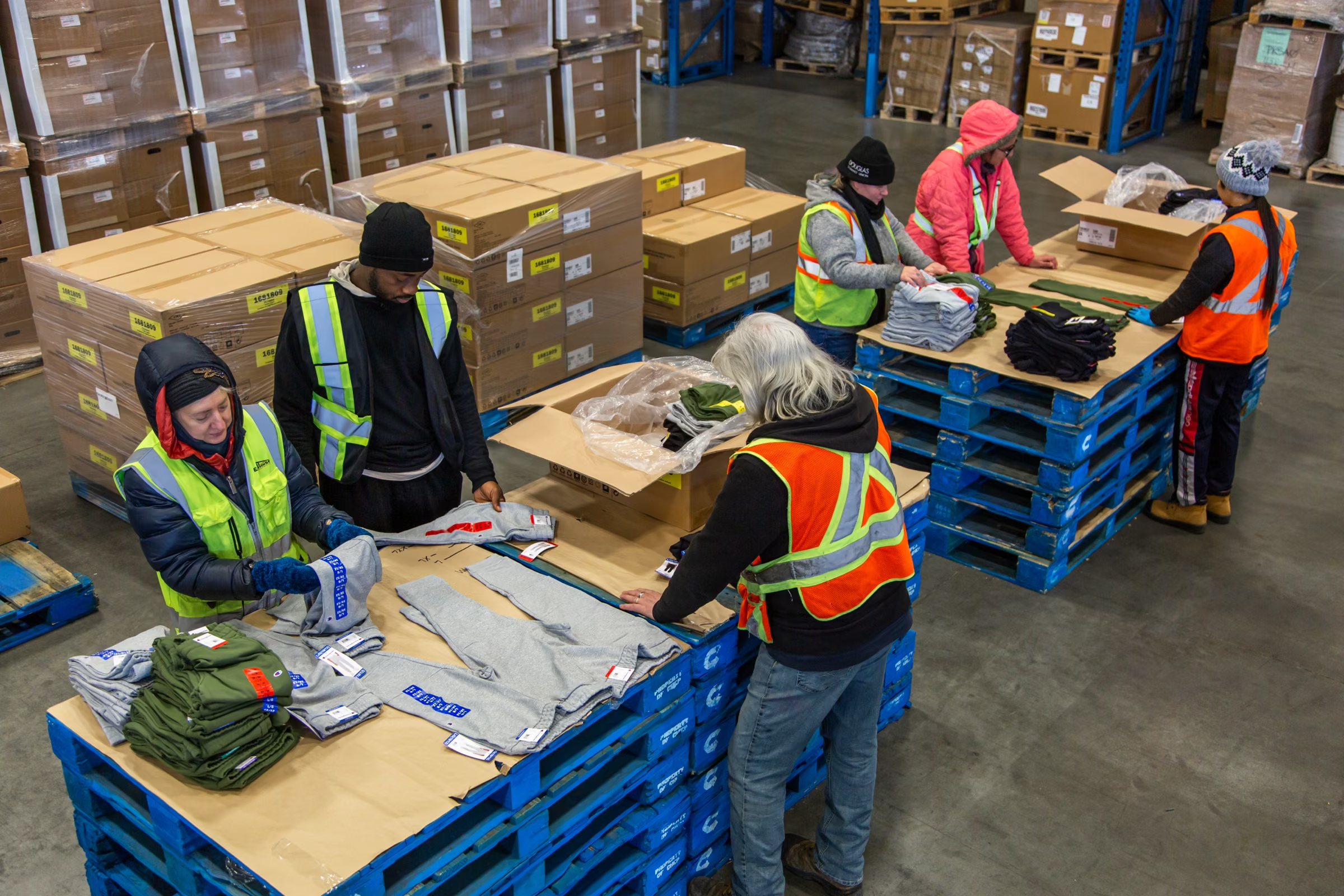
A good toys 3PL agrees a written staffing plan before peak. Second shift, weekend ops, and dock-door capacity scale on a schedule you approve, not improvised the week the curve bends.
Toys and games fulfillment for Shopify and Amazon brands. Built for the Q4 surge that does 6-11x your daily volume.
Trusted by toys and games brands shipping across North America

Toyota

Rad Power

Mystery Ranch

Brooklyn Bicycle

Cobian

BOCCI

Merkury




Written by the Vertex operations team
Marco, Kim, Tom & Sara · Receiving, Pick & Pack, FBA Prep, Account Management
Last reviewed by our toys & games ops lead against current packout specs, carrier rules, and toys and games brands feedback.
Toys and games brands live or die on a 60-day window. The same warehouse that ships 800 orders a week in August has to ship 8,000 a week in early December without dropping accuracy. The 3PL that runs through holiday peak with retail compliance, CPSIA label checks, and post-holiday returns intact is a different operator from the one that ships year-round-flat consumer goods.
Key takeaways
Same-day dispatch: toys & games orders that clear QC before the daily carrier cutoff ship the same business day, with weekend coverage available through peak.
Holiday peak is 6-11x normal volume — labor and dock capacity have to scale by October 1, not December 1
CPSIA tracking labels and age-grade routing live at the SKU catalog, not in packer judgment
Bundles and multi-packs are kit-on-the-fly, not pre-built — pre-built blows up in returns and overstock
Post-holiday returns spike runs January through mid-February, and the refurb-vs-destroy decision drives margin
Why toys & games
The average toys brand does 35 to 55% of annual revenue in November and December. A 3PL that runs flat ops staffing through Q4 cannot ship the peak, full stop. Second-shift and weekend coverage should be in place well before Thanksgiving — the ramp curve already bends mid-October on Amazon-listing brands and earlier on retail-feeder brands shipping to Walmart and Target distribution centers.
Channel mix in toys leans heavier on Amazon and big-box retail than DTC pure-play, but Shopify is the growth lane and the brand-experience lane. A typical toys brand runs Amazon FBA for volume, Shopify for margin and brand control, and EDI 850/856 to Walmart, Target, or specialty retail for shelf placement. The 3PL needs to flip between FBA carton specs, retail UCC-128 case labels, and DTC packout in the same shift, because the same SKU ships through all three lanes.
CPSIA compliance is non-negotiable. Every product sold to children under 12 needs a tracking label that ties the unit back to the batch, manufacturer, and date. Choking-hazard small parts under age 3 need the explicit warning copy on retail packaging. Read the age grade from the SKU catalog at receipt and refuse cartons that arrive without the required labels, instead of accepting them and getting fined on the retail side later.
What it unlocks
Vertical-specific operations, mapped to the failure modes the category produces.
A good toys 3PL agrees a written staffing plan before peak. Second shift, weekend ops, and dock-door capacity scale on a schedule you approve, not improvised the week the curve bends.
Age grade, tracking label format, and choking-hazard copy live at the catalog level. Inbound that arrives without the required labels gets refused at the dock, not silently accepted and shipped into a fine.
Multi-packs and gift bundles assemble at pick, not pre-built. Components stay in single-SKU inventory until the order fires, so post-holiday overstock breaks back to sellable units instead of dead bundle SKUs.
January return volume runs multiples above steady-state. A refurb-vs-destroy decision tree in the WMS per SKU, returns staffing scaled for the spike, and a target of saleable units back to inventory inside a few days of dock arrival.
For Shopify brands
Shopify is the brand-control channel for toys brands. Most run Shopify plus Amazon plus retail wholesale, and the 3PL question is whether your DTC volume justifies a vertical-aware operator or whether a generic 3PL gets you through the year.
Yes if
No if
Below 250 orders steady-state with no peak curve, a generic 3PL is cheaper. Above that, the peak ramp staging and retail compliance pay back in the first holiday season.
For Amazon FBA brands
Toys on Amazon is most brands' volume engine. FBA prep gets stricter every year, and the toys-and-games category has CPSIA prep failure rates higher than most categories because Amazon enforces the age-grade and tracking-label rules at the prep step.
Yes if
No if
Amazon-only toys brands often start FBA-direct. Once Shopify and retail kick in, the unified pool prevents the late-October "we are out of stock on Amazon but have 4,000 units in the retail bay" problem.
Scope
A toys-and-games 3PL needs to run the work that is specifically toys: CPSIA label verification at receipt, age-grade routing on bundles, retail EDI for Walmart and Target lanes, kit-on-the-fly bundles that break back to single SKUs after peak, and a returns workflow that triages January volume without dropping inventory accuracy. The brand should not have to chase any of it.
A good 3PL will not write your CPSIA compliance copy, will not design your packaging, and will not negotiate your retail compliance routing guides. Those are inputs the operation reads; the work is the operation.
✓ The 3PL owns
✗ The brand owns
Order flow
Every toys and games brand sees the same operational rhythm: receive, scan, slot, pick, pack, ship, track. The category-specific work happens at the pack station and on the exception desk. Here is the exact path, with the toys & games-specific checkpoints inside it.
Inbound carton lands at the dock. The pallet is photographed, cases counted against the ASN, and CPSIA tracking labels verified before cases enter inventory.
Toys inbound is where retail fines start. A case without the required tracking label cannot ship to Walmart or Target — refuse it at the dock instead of silently accepting it and discovering the gap on the retail bay.
Every unit scanned against the catalog. Age grade, choking-hazard flag, tracking label code, and batch code captured at receipt.
Age grade drives bundle eligibility. A 3-plus SKU cannot legally bundle with an under-3 SKU without explicit labeling — the WMS blocks the combination instead of trusting packer memory.
A-class SKUs go to the fast-pick zone. Seasonal SKUs (holiday, summer outdoor) stage to peak racks ahead of the curve bend.
Toys Pareto sharpens in peak. The top 15 SKUs become a majority of orders in December. Restage to peak-zone ahead of Thanksgiving so pick paths stay short when volume hits.
Order arrives from Shopify, Amazon, retail EDI 850, or marketplace. The channel, bundle tag, age-grade rule, and gift-message field route the order.
A retail EDI 850 routes to UCC-128 case-label pick. A Shopify order routes to DTC packout. A bundle SKU routes to kit-on-the-fly assembly. The WMS reads the order and decides — packers do not memorize routes.
Address validated against USPS and Canada Post. Holiday fraud-pattern check. Anything flagged holds for review.
Holiday fraud spikes. Card-not-present, free shipping, same-city stack, and high-value gift sets are the pattern. The review queue catches them before pick, not after dispatch.
Every unit barcode-scanned at the bin. WMS verifies SKU, qty, variant, and bundle component count against the order.
Scan-confirmed picks close the accuracy gap visual picks open. In peak, scan-confirm prevents the wrong-toy ship that turns into a refund plus a one-star review in the worst week of the year.
Bundle components meet at the kit station. Packer assembles per the photographed bundle spec, drops insert card, applies bundle barcode.
Pre-built bundles are dead inventory after the holiday window. Kit-on-the-fly keeps components in single-SKU inventory; post-holiday overstock breaks back to sellable units instead of stranded bundle SKUs.
Pack station scale verifies weight matches the BOM. Gift-wrap and gift-message orders route to gift-wrap station before sealing.
Gift-message orders need a different finishing step. Routing them to a dedicated station prevents the gift-card-on-self-purchase mistake that kills the holiday customer.
Multi-carrier rate shop picks the best service for DTC. Retail orders print UCC-128 case labels and ASN-tied pallet labels for the EDI 856.
Retail compliance chargebacks are the silent margin killer. UCC-128 on the wrong label position is a meaningful chargeback per shipment at the major accounts. Print to the routing-guide spec, not generic carton labels.
Trailer sealed, seal number logged, first-scan watched. Retail loads get appointment-confirmed at the receiving DC.
A retail load that arrives without an appointment gets refused at the DC, which is a same-week revenue hit during peak. Confirm appointments before tender, not after.
Pricing reality
Most 3PL pricing comparisons get hung up on pick-and-pack rates, which are usually within a penny or two between providers. The real difference shows up in receiving, storage, and how toys & games-specific exceptions are billed. Here is where to look:
| Cost area | How it's charged | What raises the invoice | What you must define |
|---|---|---|---|
| Pick + pack | From $1.05 per order, scoped to mix and packout | Bundle assembly, gift wrap, multi-SKU orders, retail UCC-128 label prep | Whether bundle assembly counts as kit labor or rolls into base pick rate |
| Peak surcharge | Quoted on call, peak-window premium | Same-day cutoff held through peak, weekend ops, second-shift coverage | When peak rate starts and ends, whether retail EDI lanes carry the same premium |
| Retail compliance + EDI | Quoted on call, per UCC-128 label and EDI transmission | Multi-store retail routing, pallet label compliance, ASN re-transmissions on errors | Which retail accounts are active and which routing guides the catalog supports |
| Returns processing | Quoted on call, base plus per-unit inspection | Refurb-and-restock vs destroy, damaged-packaging re-box, missing-component triage | Per-SKU rules: refurb threshold, destroy threshold, missing-component disposal |
| Storage | Per cubic foot or pallet, scoped to volume | Pre-holiday overstock, January returns inventory, dead bundle SKUs | Markdown date so unsold holiday stock does not eat margin through Q1 |
Failure modes
Five failure modes specific to toys & games, not generic 3PL problems. The ones that hit at the pack station, the carrier hand-off, and the returns desk.
| Failure mode | Why it happens | How Vertex handles it |
|---|---|---|
| Peak ships late, accuracy drops | Labor not staged ahead of the curve, second shift added late when curve already bent | Written staffing plan signed before peak. Second-shift, weekend ops, and dock capacity expand on a calendar, not by improvisation. |
| Retail chargeback for missing UCC-128 | Generic carton label used on a Target or Walmart load, routing guide not followed | Retail account flag at WMS level. EDI 850 inbound routes to UCC-128 print queue. Generic label cannot fire on retail-tagged orders. |
| CPSIA fine on retail shipment | Tracking label missing on inbound carton, accepted at dock without verification, shipped to retail | CPSIA verification at receipt. Cartons without tracking labels get refused at the dock and the supplier gets notified same-day. |
| Pre-built bundle stranded post-holiday | Bundle SKUs assembled in October cannot sell after January, breakdown labor not budgeted | Kit-on-the-fly assembly at pick. Components stay in single-SKU inventory; no bundle SKU ever ages out. |
| January returns crush, inventory inaccurate | Returns staffing flat, receiving queue grows past a week, units lost in dock chaos | Returns staffing scaled for the spike. Saleable units back to inventory in a few days; inspected, photographed, and disposed within the week. |
When this isn't a fit
We are not the right fit for every toys-and-games brand. If your steady-state volume is under 250 orders a month and peak does not exceed 1,500, a generic 3PL is cheaper and the toys-specific overhead does not pay back. If you have no CPSIA tracking labels on your inbound and no plan to add them, we cannot ship your product to retail at all — and we will not ship it to DTC where the same fine risk applies.
Under 250 orders per month steady-state with peak under 1,500
No CPSIA tracking labels on inbound and no plan to add them
Single-SKU brand with no bundle, retail, or age-grade workflows
Need same-hour fulfillment (we run same-shift, not same-hour)
Hobby or collectible brand with year-round-flat curve and no holiday peak
Comparison
We are not the right fit for every toys & games brand. Here is how we stack against the alternatives, and where we would send you if we are not it.
Toys and games brands shipping DTC plus Amazon plus retail with real holiday peak
National multi-node platform 3PL
Enterprise-scale operators serving retail-feeder toys brands
Multi-vertical, not toys-specialized
Vertex pricing
Pick-and-pack starts at $1.05 per DTC order. Everything else is scoped to your SKU mix, channel set, and packout spec. Show us your current 3PL invoice and we'll tell you where we beat it, line by line.
Pick & pack
Per DTC order, standard SKU
from $1.05 /order
Everything else
Receiving, storage, FBA prep, kitting, returns, multi-channel routing — quoted on a call against your real order volume and SKU profile. We do not publish a per-pallet or per-cu-ft rate sheet because the honest answer depends on what you ship.
Bring your current invoice
Already at another 3PL? Send us your last three invoices. We will reply with a side-by-side and tell you whether we can beat it. If we cannot, we will say so.
What every toys and games brand gets
Bring your current invoice. We will reply with a line-by-line comparison.
FAQs about toys & games fulfillment
Yes. Toys & Games orders that clear QC before the daily carrier cutoff are picked, packed, and handed to the carrier the same business day, with weekend coverage available during peak. We confirm your exact cutoff time and SLA on the discovery call.
Peak ramp is a written plan agreed ahead of the curve. Second-shift coverage, weekend ops, and dock capacity expand on the schedule rather than late November. Same-day cutoff holds through the peak window on DTC; retail lanes follow the routing-guide tender windows. Peak is not improvised.
Yes. Age grade and tracking label format live at the SKU catalog. Inbound cartons that arrive without the required labels get refused at the dock and the supplier gets notified same-day. Age-grade bundle rules prevent illegal combinations from being assembled at pick.
Yes. EDI 850, 856, and 810 transactions, UCC-128 case labels, pallet labels, and routing-guide compliance for the major retail accounts. The retail flag lives at the WMS level so retail-tagged orders cannot accidentally ship on a generic DTC label.
Kit-on-the-fly at pick, not pre-built. Components stay in single-SKU inventory until the order fires. Post-holiday overstock breaks back to sellable units instead of stranded bundle SKUs that cannot move after January.
Returns staffing scales for the post-Christmas spike. Saleable units land back in inventory inside a few days of dock arrival. Refurb-vs-destroy decisions follow per-SKU rules in the WMS rather than ad-hoc judgment at the inspection table.
Damage rate tracks well below the category norm on standard packaged toys. Plush, blind boxes, and box-set games are lower; fragile collectibles with glass or porcelain components track to beauty-grade packout. Per-SKU packout spec is mandatory on fragile variants.
Targeting a five-day onboarding cadence: contract signs and ops lead named, SKU catalog mapped with CPSIA and age-grade flags applied, bundle BOMs documented and retail compliance accounts mapped, test orders run end-to-end, shipping and EDI accounts connected, first inbound received, and the order feed flipped on.
Practical floor is 250 orders per month steady-state with peak above 1,500. Below that, a generic 3PL is cheaper and the peak ramp and retail compliance overhead does not pay back. We are happy to refer you to a boutique operator if you are not at scale yet.
Related verticals
Related services
Ready to ship toys & games the right way?
Get a custom quote in 24 hours based on your SKU mix, order volume, and toys & games packout spec. Same-shift cutoff. 24-hour receipt-to-pickable. No annual contract.
5-day onboarding · 24h receipt-to-pickable · No annual contract