Marco, Kim, Tom & Sara
· Receiving, Pick & Pack, FBA Prep, Account Management
Last reviewed by our team on May 10, 2026 against current Port of Montreal + Cushman Quebec + Bill 96 + Stat Canada data.
Most brands shopping for a 3PL in Montreal think they are buying a Port of Montreal warehouse. That is the 2019 pitch. The 2026 pitch is a stack of three events that hit in 2025 and reset the operating math.
On June 1, 2025, Quebec Bill 96 packaging amendments came into force, requiring French-language packaging for every consumer-product brand selling in Quebec, with a transition window to June 1, 2027. On August 29, 2025, US Customs and Border Protection fully suspended Section 321 de minimis on every commercial shipment, killing the Canadian DTC US-shipping shortcut. On January 22, 2025, Amazon Canada closed all seven Quebec warehouses, laid off roughly 1,700 workers, and dumped about 2.0 million square feet of Class A spec product onto the Montreal sublease market.
The credible Montreal 3PL play in 2026 is the brand that handles Bill 96 bilingual packaging natively, runs a US warehouse in the network for cross-border at COGS, and leases metro-corridor taking-rate stock instead of downtown Montreal premiums. We operate from the Montreal area as part of our 10-warehouse US and Canadian network and run that model natively. This page covers what we ship from where, what we charge, where we win, and where we send you to a competitor.
Key takeaways
1
Three 2025 events reset the Montreal 3PL math: Bill 96 packaging law in force June 1, 2025 (transition to June 1, 2027), full Section 321 de minimis suspension on August 29, 2025, and Amazon Quebec closing all seven warehouses on January 22, 2025. We handle Bill 96 bilingual kitting natively, run cross-border at COGS via a US warehouse in our network, and lease taking-rate stock in the corridor where it makes sense.
2
Port of Montreal handled 1.52M TEU in 2025 (+3.6% YoY, Montreal Port Authority annual report), with the $1.16B Contrecoeur expansion (Canada Infrastructure Bank loan, DP World Canada operator) adding 1.15M TEU annual capacity by 2030. YUL Montreal-Trudeau moved 158,020 metric tonnes of air cargo in 2024 and YMX Mirabel is Canada's dedicated 24/7 all-cargo airport. CN Rail is headquartered in Montreal; CPKC runs the single-line Canada-US-Mexico network through here.
3
Montreal industrial inventory totals 355.8M SF with 7.4% vacancy and $14.20 PSF average net rent, down 14 to 16 percent from the $16.80 peak in Q2 2023. Our Montreal-area facility sits in the metro corridor at the taking rate, not downtown premiums.
4
We fit Canadian and US DTC brands at 200+ DTC orders per month with Quebec demand (Bill 96 applies), Atlantic Canada + US Northeast cross-border via the Champlain crossing, or import volume through Port of Montreal. Below 200 orders per month, or for brands not selling into Quebec, or for bonded sufferance plays, smaller boutiques like Bulletproof Logistics, Shiporo, or 3DM Logistics beat us on cost, and Toronto is the better geography if Bill 96 does not apply.
Why Montreal
Why Montreal is the stacked compliance + duty + sublease arbitrage market right now
Port of Montreal. 1.52M TEU in 2025 (+3.6%), Canada's primary Atlantic-coast container gateway, with $1.16B Contrecoeur expansion adding 1.15M TEU by 2030.
Three things changed in 2025 that every Montreal 3PL marketing page either dodges or hasn't updated. First, Quebec Bill 96 packaging amendments came into force June 1, 2025, with a transition window to June 1, 2027 (McCarthy Tetrault, June 2025). Every consumer-product brand selling in Quebec now needs French-language packaging with French no less prominent than any other language, and generic or descriptive terms in trademarks must appear in French regardless of trademark registration. Toronto-only 3PLs can't kit this natively; the compliance burden bounces back to the brand. We handle bilingual labelling on-site in our Montreal-area facility. Second, US Customs and Border Protection fully suspended Section 321 de minimis on August 29, 2025 (Executive Order 14195, phased China-only May 2, 2025, then global suspension); CUSMA-qualified Canadian-origin goods still enter the US tariff-free, but goods that do not qualify pay applicable US duty. The Canadian-DTC-ships-duty-free-to-the-US playbook is dead. We run a US warehouse in our network so the customs hit happens once at COGS rather than per parcel at retail. Third, Amazon Canada closed all seven Quebec warehouses on January 22, 2025, laid off roughly 1,700 workers, and dumped about 2.0 million square feet of Class A spec product onto Montreal's sublease market. Colliers Q3 2025 reports that Amazon accounts for 54% of the record 3.8 MSF Montreal sublet pool. That overhang is the most distressed brand-grade industrial product in any major Canadian market in 2026.
The Montreal port and air story is real but it is not where most marketing pages should be leading. Port of Montreal handled 1.52 million TEU in 2025, +3.6 percent year over year, with 12.3 million tonnes of container cargo and 34.3 million tonnes total cargo across the year (Montreal Port Authority annual report 2026). Port revenues hit $155.4M with EBITDA at $63.3M, and S&P upgraded the port to AA in April 2026. The Contrecoeur Terminal expansion is the bigger forward story: a $1.16 billion Canada Infrastructure Bank loan, a $609 million civil works contract to the CTCGP consortium, in-water construction started October 2025, DP World Canada as the operator, and 1.15 million TEU of new capacity targeting commercial operations in 2030. YUL Montreal-Trudeau handled 158,020 metric tonnes of air cargo in 2024 with 156 direct destinations and is one of nine Canadian airports with US Border Preclearance. YMX Mirabel is Canada's dedicated 24/7 all-cargo airport on 4,400 hectares with one of Canada's longest runways and no operating restrictions. CN Rail is headquartered in Montreal (935 De La Gauchetiere West) with Class I rail to Halifax, Chicago, Memphis, New Orleans, Vancouver, and Prince Rupert. CPKC runs the only single-line Class I network connecting Canada, the US, and Mexico through Lachine and Saint-Luc yards. The cross-border truck story is the underrated one: Champlain / Saint-Bernard-de-Lacolle is 24/7/365 and roughly 45 minutes from downtown Montreal, putting NYC 6 hours / 600 km away, Boston 5 hours / 510 km away, and Toronto 5 to 5.5 hours / 540 km away. Champlain is the primary truck gateway between Quebec and the I-87 / I-91 corridor to the US Northeast.
The geography buyers think they are buying is wrong. "Montreal 3PL" almost never means downtown Montreal. The submarket split tells the story: Saint-Laurent near YUL, East End / Anjou port-proximate large-bay, Laval on the A-15 / A-440 spine, South Shore (Boucherville / Longueuil / Brossard), West Island (Dorval / Pointe-Claire / Baie-d'Urfe), and Vaudreuil-Soulanges greenfield 35 minutes west of downtown.
Montreal net rents are down 14 to 16 percent from the $16.80 PSF peak in Q2 2023. We operate from the broader Montreal metro at the taking-rate corridor, positioned for Port of Montreal drayage, YUL / YMX air cargo, CN / CPKC rail intermodal, and the 45-minute Champlain crossing to the I-87 corridor for US Northeast cross-border.
The honesty paragraph: Port of Montreal lost 10 days to the November 2024 longshore lockout, with $930 million per day of cargo affected across simultaneous Montreal and Vancouver lockouts. Canada Post ran a 32-day CUPW strike in late 2024 that pushed Canadian e-commerce down 30 to 40 percent year-to-date by some estimates. Montreal's operational asterisk is labor, not weather. Any Montreal 3PL that does not have a written rail-out-of-Halifax and air-out-of-Mirabel contingency plan is hiding something.
What it unlocks
What a Montreal 3PL gets you that a Midwest 3PL can't
We operate in the Montreal area as part of our 10-warehouse US and Canadian network, positioned for Port of Montreal drayage, YUL Montreal-Trudeau air cargo, YMX Mirabel freighter coordination, CN / CPKC rail intermodal, and the Champlain crossing for US Northeast cross-border bulk transfer.
01
Bill 96 bilingual fluency, native
Quebec Bill 96 packaging amendments are in force (June 1, 2025; transition to June 1, 2027). We handle French-language kitting on-site in our Montreal-area facility as part of the workflow, not as a separate charge, with French no less prominent than any other language. Toronto-only 3PLs can't kit this natively.
02
Saint-Laurent / Anjou taking rate
Our facility sits 12 miles from downtown Montreal at $13.50 CAD NNN per square foot per year (Cushman & Wakefield Q1 2026), versus downtown Montreal and West Island specialty warehouses charging 20 to 35 percent more. Net rents are down 14 to 16 percent from the $16.80 peak in Q2 2023.
03
Champlain crossing dual-country
We run a Montreal-area facility alongside US warehouses in our 10-warehouse network on one inventory pool. Bulk-transfer US-bound volume via the Champlain crossing so the customs hit happens once at COGS, not per-parcel at retail. Section 321 is dead; this is the only sane model for Montreal brands with US Northeast demand.
04
Multi-modal inbound: port, rail, air
Port of Montreal (1.52M TEU in 2025, +3.6% YoY; $1.16B Contrecoeur expansion adding 1.15M TEU by 2030), CN Rail HQ in Montreal, CPKC Canada-US-Mexico single-line, YUL with US Border Preclearance and 158,020 MT of air cargo in 2024, and YMX Mirabel as Canada's dedicated 24/7 all-cargo airport. The contingency stack a Montreal 3PL needs.
For Shopify brands
Should Shopify store owners have a 3PL in Montreal?
A Montreal 3PL is the right call for a Shopify brand when you sell into Quebec under Bill 96 packaging law, ship into Atlantic Canada or the US Northeast via the Champlain crossing, or import through Port of Montreal. If your demand is heavily Ontario / Alberta / BC and you do not sell into Quebec, Toronto is the smarter call. If your US demand exceeds 30% of orders, the Montreal-to-Champlain geography only works with a US warehouse in our network.
Yes if
You sell into Quebec. Bill 96 packaging amendments came into force June 1, 2025 (transition to June 1, 2027). Toronto-only 3PLs can't kit French-language packaging natively without bilingual labelling capabilities; the compliance burden bounces back to the brand. We handle bilingual labelling on-site in our Montreal-area facility as part of the workflow, not as a separate charge.
You sell into Canada AND your US order share is 30% or more. Section 321 suspension and applicable US duty on non-CUSMA goods make per-parcel cross-border DTC math punitive. Bulk-import to a US warehouse via the Champlain crossing (1 hour to NY, 5 hours to Boston, 6 hours to NYC), fulfill domestic-US, ship Canadian volume from our Montreal-area facility.
You import via Port of Montreal (1.52M TEU in 2025, +3.6% YoY, with the $1.16B Contrecoeur expansion adding 1.15M TEU by 2030) or use YUL / YMX air cargo. Our Montreal-area facility sits 12 miles from the port and is positioned for YUL pickup and YMX freighter coordination.
You ship 200+ DTC orders per month with Quebec demand and Atlantic Canada or US Northeast outbound. Below that floor, smaller Montreal boutiques (Bulletproof Logistics, Shiporo, 3DM Logistics, TSPM Entrepot, Precise Warehousing) beat us on cost.
No if
You do not sell into Quebec. Bill 96 does not apply, the French-language kitting differentiator disappears, and our /locations/canada/ontario/toronto-3pl page is the smarter geography for Canadian DTC in a tighter, larger 850 MSF GTA market.
Your demand is 100% Canadian and under 500 orders/month with no US volume. Smaller Montreal-only operators (Bulletproof, Shiporo, 3DM) will run cheaper at your volume; we work best at 200 orders and up.
Cold-chain pharma GMP fulfillment. Our Montreal-area facility runs ambient-only. Bulletproof Logistics specifically markets Health Canada pharmaceutical relabelling and HACCP-certified food ops as a service.
You need CBSA-licensed bonded sufferance warehouse storage for high-volume tariff-cycle plays. We are not a sufferance facility; we refer to specialists.
If "yes" lands on you, the next question is which Shopify-side workflow tests separate ops-grade Montreal 3PLs from ones that look good on a sales call but break under Bill 96 SKU routing or post-2024 Canada Post diversification pressure. Six questions to ask any operator below.
Workflow
What should happen
What usually breaks
Question to ask
New order arrives
In the pick queue at the correct node near real time, with French-labelled SKU variant picked for Quebec ship-to
Polling intervals over 5 minutes; English-only SKU picked for Quebec orders; orders routed to wrong country
How often does sync run, how does the WMS route Canada vs US, and how does it pick the Quebec French-labelled SKU variant under Bill 96?
Inventory level changes
Pushes back to Shopify in real time, both nodes combined, with separate Quebec and non-Quebec SKU pools
Daily batch updates; oversells during peak; Quebec stock shown as available when only English variants remain
Is inventory sync push or pull, single-pool or split, and how are Quebec French-labelled SKUs tracked separately?
Tracking number written
Posts to Shopify the moment carrier scans, both nodes
Manual upload at end of day; customer emails arrive late
When exactly does tracking hit Shopify, and how is it tagged by node?
Pre-order / backorder
Order holds, ships when stock arrives at the correct node and (for Quebec) in the French-labelled variant
Order silently fails or ships partial without notice; English variant shipped to Quebec customer
How does your WMS handle backorders across two nodes and across Bill 96 SKU variants?
Returns refund trigger
Refund triggers on return scan-in (or on inspection pass)
Returns sit unprocessed for days; cross-border returns lost in customs
What event triggers the refund, and how do you handle a US customer returning to Canada?
Carrier diversification post-2024
Default route via Purolator / UPS Canada / FedEx Canada with Canada Post as a flagged fallback only
Default route to Canada Post; if Canada Post strikes again (32-day CUPW strike late 2024), DTC ships stop
What is your primary Canadian carrier mix, and what is the documented fallback if Canada Post strikes again?
For Amazon FBA brands
Should Amazon FBA brands have a 3PL in Montreal?
A 3PL in Montreal alongside Amazon FBA gets specific value when you sell on Amazon.ca AND Amazon.com and want one inventory pool feeding both marketplaces from a Quebec geography with Bill 96 bilingual handling built in. Pure FBA-only Canada-only brands rarely need it unless Quebec demand is large; pure Amazon.com US sellers should run inventory from a US 3PL.
Yes if
You sell on Amazon.ca AND Amazon.com with Quebec demand. We prep and route to YUL2, YUL3, and YHU3 from our Montreal-area facility and to US FBA codes from a US warehouse in our network, all on one inventory pool with Bill 96 French-labelled SKU variants tracked separately. FBA labeling, polybagging, and inbound shipment plans are included on both Amazon.ca and Amazon.com.
You sell on Amazon AND Shopify (or DTC). FBA does not handle your DTC orders. We do both from our Montreal-area facility plus a US warehouse in our network.
You want to throttle FBA storage during slow seasons. We hold overflow at our Montreal-area facility or a US warehouse in our network and re-route to FBA when demand returns, sidestepping FBA long-term storage fees on both Amazon.ca and Amazon.com.
You import bulk into Canada via Port of Montreal under CUSMA and want to feed both Canadian and US Amazon channels without per-parcel customs friction. The Champlain crossing 1-hour run to NY makes the bulk transfer cheap and fast.
No if
100% Amazon.ca, no other channel, under 200 orders/month, no Quebec demand. Going direct to FBA from your supplier (with a freight forwarder) is usually cheaper.
100% Amazon.com US sellers with no Canadian demand. Run inventory from a US 3PL in LA, Atlanta, or the US Northeast; routing through Montreal adds a customs leg with no upside.
Domestic suppliers west of Ontario. If your inventory ships from a Prairie or BC factory, the Eastern Canada geography does not apply. A Toronto or Vancouver / Calgary 3PL saves freight on the inbound leg.
Multi-channel sellers running both Amazon.ca and Amazon.com with Quebec demand benefit from a Montreal 3PL specifically because one inventory pool feeds both marketplaces, dual-FBA prep happens under one roof, and Bill 96 bilingual SKU variants are routed natively rather than retro-fitted by a Toronto-only operator.
Scope
What a Montreal 3PL should and shouldn't handle
A common mistake brands make when scoping a Montreal 3PL is treating it as a generic warehouse. Warehouses store things. A 3PL is closer to an operations team that happens to live in a warehouse. Knowing the line between what we own and what stays with your team prevents the most common onboarding fights, especially when Bill 96 bilingual packaging, CUSMA classification, post-Section-321 cross-border routing, and Port of Montreal drayage enter the picture.
✓ The 3PL owns
Receiving containers via Port of Montreal drayage to our Montreal-area facility, CN / CPKC rail intermodal at Lachine and Saint-Luc, or CBSA cross-border road from US suppliers via Champlain
Bill 96 bilingual labelling and kitting on-site: French-language packaging, French generic or descriptive terms, French no less prominent than any other language on the package
Storing inventory in racked, lot-tracked, FIFO-rotated locations at our Montreal-area facility
Picking, packing, and shipping DTC orders against a 3 PM ET same-day cutoff for Canada-bound parcels
Routing US-bound volume in bulk to a US warehouse in our network for domestic-US fulfillment, sidestepping per-parcel US duty
Routing inbound shipments to Amazon FBA Canada (YUL2, YUL3, YHU3) and US FBA codes from a US warehouse in our network
FNSKU re-validation and FBA spec updates on both Amazon.ca and Amazon.com
CUSMA rules-of-origin documentation pass-through for goods qualifying as Canadian-origin
YUL air cargo pickup and YMX Mirabel freighter coordination for time-sensitive or high-value inbound
Returns receiving, inspection, restocking or disposition per your written rules, with separate Canada and US returns flows
EDI-compliant retail outbound (856 / 940 / 810) for Shopify B2B and Quebec / Atlantic Canada retail accounts
✗ The brand owns
Bill 96 trademark registration and French-language legal review. We apply the French packaging your trademark counsel approves; we do not certify Charter of the French Language compliance.
CUSMA classification audits per SKU. We pass through what your customs broker certifies; we do not certify origin ourselves.
GMP cold-chain pharma fulfillment. We are ambient-only; we refer pharma cold-chain to Bulletproof Logistics or other Health Canada GMP specialists.
CBSA-bonded sufferance customs storage for high-volume tariff-cycle plays. We are not a CBSA-licensed sufferance facility; we refer to specialists.
Demand planning and reorder timing across the two nodes. You own this; we feed the data.
Customer service and chargebacks. We feed tracking and exception data; your CX team handles the conversation.
Marketing copy on packing slips and inserts. You supply the artwork; we apply it.
Carrier rate negotiation. You can use your own carrier accounts; we route to whichever rate card you supply.
Order flow
Inside a Montreal 3PL: 10 steps from Port of Montreal or YUL / YMX air to porch
From Port of Montreal drayage to our Saint-Laurent / Anjou / Laval / Boucherville cluster (12-mile run), with YUL / YMX air cargo as the secondary lane and CN / CPKC rail intermodal at Lachine and Saint-Luc as the tertiary lane, to the moment your customer's parcel scans on their porch. Here is the exact path. Ten steps, mapped to who does what and where the typical 3PL drops the ball.
01
Inbound notice
Your supplier or freight forwarder sends an ASN (Advance Shipping Notice) or simple email with PO, expected SKUs, container count, ETA, and CUSMA origin documentation. We pre-allocate a receiving dock window in our Montreal-area facility or at a US warehouse in our network.
What is this?
An ASN is a structured file (EDI 856 or our standard CSV / spreadsheet) that lists every SKU, expected quantity, container or pallet ID, ETA, and (for cross-border inbound) CUSMA rules-of-origin certification. With an ASN, our receiving team pre-prints labels, pre-assigns rack locations, and starts unload the moment the truck or rail intermodal container checks in. Without an ASN, every container takes 2 to 4 extra hours because we have to reverse-engineer the shipment on the dock. We accept both EDI and a simple template if your supplier is small.
02
Port, rail, or border arrival
Container arrives at our Montreal-area facility via Port of Montreal drayage (12-mile run), CN / CPKC rail intermodal at Lachine or Saint-Luc, CBSA cross-border road from US suppliers via Champlain, YUL air cargo pickup, or domestic LTL. Driver checks in, dock door is assigned, unload begins.
What is this?
Port of Montreal moved 1.52M TEU in 2025 (+3.6% YoY, Montreal Port Authority) and dray to our facility runs 12 miles. CN Rail (headquartered in Montreal) and CPKC (the only single-line Canada-US-Mexico network) move intermodal through Lachine and Saint-Luc yards. CBSA cross-border road inbound from US suppliers clears at Champlain / Saint-Bernard-de-Lacolle (24/7/365, roughly 45 minutes from us, the primary Quebec truck gateway to the I-87 / I-91 corridor). YUL handled 158,020 metric tonnes of air cargo in 2024 and YMX Mirabel runs 24/7 all-cargo with one of Canada's longest runways. Domestic restocks and sample shipments arrive via standard LTL.
03
Receive + count
Cases are unloaded, scanned, counted against the ASN. Discrepancies (short / over / damaged) are flagged and photo-documented inside 24 hours. CUSMA paperwork files with the receipt record.
What is this?
Every case gets a barcode scan against the ASN line item. If the count matches, the SKU moves to putaway. If it does not (short ship, over-ship, damaged outer), our team photo-documents the variance with timestamps and dock-door ID, then logs it in our exception queue. You get an email within 24 hours with the photos, the variance, and our recommended next step (claim with carrier, request supplier credit, accept and adjust on-hand). For cross-border inbound, the CUSMA certificate-of-origin filed at receipt feeds your customs broker for audit defense.
04
Bill 96 bilingual kitting
For SKUs sold into Quebec, French-language packaging or stickering is applied on-site against your trademark counsel's approved spec, with French no less prominent than any other language on the package.
What is this?
Quebec Bill 96 packaging amendments came into force June 1, 2025 (transition window to June 1, 2027 per McCarthy Tetrault, June 2025). Generic and descriptive terms in trademarks must appear in French regardless of trademark registration, and French must not be less prominent than any other language. We apply the French packaging your trademark counsel certifies, log the kit-level work in the WMS, and stage Quebec-destined inventory separately from non-Quebec stock so French-language SKUs do not commingle with English-only variants. We do not certify Charter of the French Language compliance ourselves; your counsel owns that piece.
05
Putaway
SKUs are binned to designated rack or floor locations using our WMS. Lot codes and expiry dates captured at this step for food / supplements / beauty SKUs. US-destined inventory tags route to a US warehouse in our network.
What is this?
Putaway is the act of moving received cases from the dock to a permanent rack or floor location. Our WMS assigns the location based on velocity (fast-movers near the pack table, slow-movers in deep storage), pallet height, and lot rotation rules. For food, supplements, and beauty SKUs we capture lot code and expiry at putaway so FIFO (First-In-First-Out) picks always grab the earliest-expiring stock first. Inventory tagged for US fulfillment gets a transfer flag and ships in bulk to one of our US warehouses via the Champlain crossing, sidestepping per-parcel US duty.
06
Order sync
A good WMS pulls orders from Shopify, Amazon.ca, Amazon.com, BigCommerce, and your ERP near real time. New orders appear in the pick queue at the right node automatically. We run Datex Footprint for this.
What is this?
Order sync is the live link between your sales channels and our pick queue. A good WMS polls Shopify, Amazon Seller Central (both .ca and .com), BigCommerce, and ERP systems frequently so the order is in the pick queue shortly after checkout. We run Datex Footprint for this. The routing engine reads the ship-to country and (for Canada-bound) the province, and assigns the order to our Montreal-area facility (Canada-bound, with the Quebec-province flag picking the French-labelled SKU variant under Bill 96) or a US warehouse in our network (US-bound). Inventory levels push back to your store when the pick is confirmed, which prevents oversells during traffic spikes.
07
Pick
Pickers scan each item against barcode and bin location. A good WMS rejects mispicks before they reach the pack table. That is how an operator holds pick accuracy in the high-nineties across both nodes.
What is this?
Picking is the moment a worker grabs the right SKU off the shelf for an order. A good WMS forces a barcode scan at every pick, comparing the scanned SKU against the order line. If they do not match, the system blocks the pick and routes the worker back to the correct bin. That double-check is what keeps a 3PL at high-nineties shipped-correct accuracy, and the same logic should run identically at our Montreal-area facility and a US warehouse in our network facility.
08
Pack + label
Packers select carton, add inserts, generate carrier label, weigh, and tape. Each pack table runs a triple-check process before the parcel leaves the station.
What is this?
At the pack station, the worker selects the right-size carton (we calculate dim weight to keep your shipping costs low), adds any inserts (thank-you cards, samples, marketing flyers you supply), prints the carrier label, weighs the parcel, and tapes. Three checks happen before the parcel leaves: SKU match, label match, and weight sanity check. If any fail, the parcel goes to a re-pack station before it ships. Canada-bound parcels ship from our Montreal-area facility; US-bound parcels ship from a US warehouse in our network via the Champlain crossing bulk transfer, no per-parcel cross-border duty.
09
Carrier handoff
Parcels stage by carrier (Canada Post, Purolator, UPS Canada, FedEx Canada, ICS Courier, USPS, UPS, FedEx at a US warehouse in our network). Carrier sweeps happen at fixed daily windows. Tracking pushes back to Shopify and Amazon automatically.
What is this?
Parcels stage in carrier-specific zones near the loading dock. Canada Post, Purolator, UPS Canada, FedEx Canada, ICS, and DHL each have their own daily sweep window with us in our Montreal-area facility; USPS, UPS, FedEx, and DHL operate the same way at a US warehouse in our network. The moment a carrier scans a label at sweep, that scan event pushes back to your Shopify or Amazon order page so the customer sees a tracking number in real time. No manual tracking uploads, no end-of-day batch lag. The 32-day Canada Post strike in late 2024 reset every Quebec brand's carrier diversification math; we route through Purolator, UPS Canada, and FedEx as primary lanes with Canada Post as a fallback.
10
Returns
Inbound returns are received at the node closest to the customer (our Montreal-area facility for Canada, a US warehouse for US), inspected against your disposition rules (restock, refurbish, scrap), and the result writes back to inventory. You get a daily returns report.
What is this?
Returns come back to a dedicated returns dock at the node closest to where they shipped from. Our team inspects each item against your disposition rules (which you set during onboarding): restock if A-grade, refurbish if B-grade and re-label, scrap if damaged. The result writes back to your inventory in real time. Your refund logic can fire on any of three triggers (parcel scan-in, inspection pass, or restock complete) so you control whether the customer gets refunded fast or only after we confirm condition. Cross-border returns (US customer returning to Canada) carry their own duty considerations, and we coordinate with your customs broker on those.
Pricing reality
What actually drives a Montreal 3PL bill
Most 3PL pricing comparisons get hung up on pick-and-pack rates, which are usually within a penny or two between providers. The real difference shows up in receiving, storage, and how exceptions are billed. Here is where to look:
Cost area
How it's charged
What raises the invoice
What you must define
Receiving
Per pallet or per container
Mixed SKUs per pallet, no ASN, missing CUSMA paperwork on cross-border inbound, Port of Montreal congestion or labor action
ASN format, palletization standard, CUSMA documentation responsibility, drayage carrier of record
Bill 96 bilingual kitting
Per unit kitted or stickered
French-language packaging or stickering volume, language layout complexity (French no less prominent than any other language), Quebec-province SKU variant management
French packaging spec approved by your trademark counsel, kit type (sticker vs new packaging), Quebec-vs-rest-of-Canada SKU separation
Storage
Per pallet / per cubic foot / month
Long-tail SKUs, slow-movers, packaging that wastes airspace
Submarket of the warehouse. The broader Montreal metro corridor sits well below downtown Montreal and West Island specialty warehouses (which charge 20 to 35 percent more).
Pick & pack
Per order, per item, sometimes per SKU
Multi-item orders with kitting, gift wrap, custom inserts
Standard SKU vs kit, included vs add-on packout steps
Carrier costs
Pass-through, sometimes with markup
Use of 3PL's carrier account vs your own, dimensional weight pricing, cross-border surcharges, Canada Post strike-risk premiums on diversified carriers
Whose carrier account, who pays surcharges (residential, peak, customs broker fee), Canada Post fallback policy
Cross-border bulk transfer
Per pallet or per truck shipment
Frequency of Champlain crossings, customs broker fee per shipment, applicable US duty on non-CUSMA goods, Champlain border processing time during US peaks
Transfer cadence, CUSMA qualification per SKU, broker of record at the border
Five Montreal 3PL failure modes (port, labor, drayage)
Five failure modes specific to LA-region fulfillment. Not generic 3PL problems. The ones that hit when port congestion stacks with peak-season demand and shared labor goes thin.
Failure mode
Why it happens
How Vertex handles it
English-only SKU shipped to Quebec customer under Bill 96
Quebec Bill 96 packaging amendments came into force June 1, 2025; Toronto-only 3PLs without bilingual kitting capability default to English SKU variants for Quebec ship-tos, and the brand absorbs the compliance and customer-experience hit.
We tag every SKU at receipt with a Quebec-vs-rest-of-Canada flag, stage French-labelled variants separately from English-only stock, and the WMS routing engine reads the ship-to province and picks the French variant for QC ship-tos. Your trademark counsel approves the French packaging spec; we apply it.
Cross-border parcel duty surprise
Section 321 suspended August 29, 2025; every commercial parcel from Canada now requires full customs clearance, and non-CUSMA goods pay applicable US duty.
We route US-bound volume in bulk to a US warehouse in our network via the Champlain crossing (1 hour to the NY state line, 5 hours to Boston, 6 hours to NYC), so the customs hit happens once at COGS rather than per-parcel at retail. CUSMA-qualified Canadian-origin SKUs ship direct from our Montreal-area facility tariff-free.
Port of Montreal labor disruption
Port of Montreal lost 10 days to the November 2024 CUPE Local 375 lockout (1,200 longshoremen; binding arbitration ordered November 12, 2024 by Labour Minister Steven MacKinnon); $930M/day of cargo affected across simultaneous Montreal and Vancouver lockouts (Al Jazeera, Reuters).
We hold pre-booked drayage windows at multiple Port of Montreal terminals, run a written contingency plan that includes rail-out-of-Halifax and YMX Mirabel air cargo as backup lanes, and pre-stage urgent inbound (live shows, FBA peak) so containers do not sit at the rail yard during labor risk windows.
Canada Post strike recurrence on DTC outbound
Canada Post 32-day CUPW strike late 2024 pushed Canadian e-commerce down 30 to 40 percent year-to-date by some estimates (Industrial Inquiry Commission report 2025, eComm North 2025); recurrence risk in 2025-26 is real.
We default-route through Purolator, UPS Canada, and FedEx Canada with Canada Post flagged as a fallback only, not a primary. Carrier diversification is built into onboarding, not added after the first strike notice.
Champlain crossing delays during US holiday peaks
CBSA and CBP processing slow at Champlain / Saint-Bernard-de-Lacolle during BFCM and December US holidays; the 24/7/365 crossing is the primary Quebec-to-I-87 truck gateway and per-truck inspection cycles get longer during peak.
We pre-clear bulk transfers with PARS (Pre-Arrival Review System) on the Canadian side and ACE eManifest on the US side, hold relationships with three cross-border carriers, and time transfers 5 to 10 days ahead of forecast peak so US inventory is in position before the rush.
When this isn't a fit
When Vertex isn't the right Montreal 3PL for you
We are not the right 3PL for everyone shipping from Montreal. Here is the honest list of cases where you should pick someone else.
You do not sell into Quebec. Bill 96 packaging law does not apply to your SKUs, the bilingual-kitting differentiator disappears, and our /locations/canada/ontario/toronto-3pl page is the smarter geography for Canadian DTC in a tighter, larger 850 MSF GTA market.
You ship under 200 DTC orders per month. Smaller Montreal-area operators (Bulletproof Logistics, Shiporo, 3DM Logistics, TSPM Entrepot, Precise Warehousing in Baie-d'Urfe, Boutin 3PL in Boucherville) and 3PL match-services will run cheaper at your volume. We work best at 200 orders per month and up with Quebec demand, or B2B and retail programs that justify dedicated handling.
You need GMP cold-chain pharmaceutical fulfillment. Our Montreal-area facility runs ambient-only. Bulletproof Logistics actively markets Health Canada pharmaceutical relabelling and HACCP-certified food ops.
You need a CBSA-licensed bonded sufferance warehouse for high-volume duty-deferred storage (up to 4 years), tariff-cycle timing, or re-export plays. We are not a CBSA sufferance facility. For brands where the bonded math justifies the overhead, we point you to specialists.
Your inventory ships from Western Canada and you sell heavily into BC / Alberta. The Montreal geography adds freight cost on both inbound and outbound legs. A Vancouver or Calgary 3PL saves freight; see our /locations/canada/british-columbia/vancouver-3pl and /locations/canada/alberta/calgary-3pl pages.
You need walk-in retail or B2C drop-off in Montreal. We do not run customer-facing counters at our facilities.
You require unstable or undefined inbound (no ASNs, surprise containers, ad-hoc SKU labelling, missing CUSMA paperwork). We can onboard this, and we will quote with a higher cost-to-serve to match.
Reach from Montreal
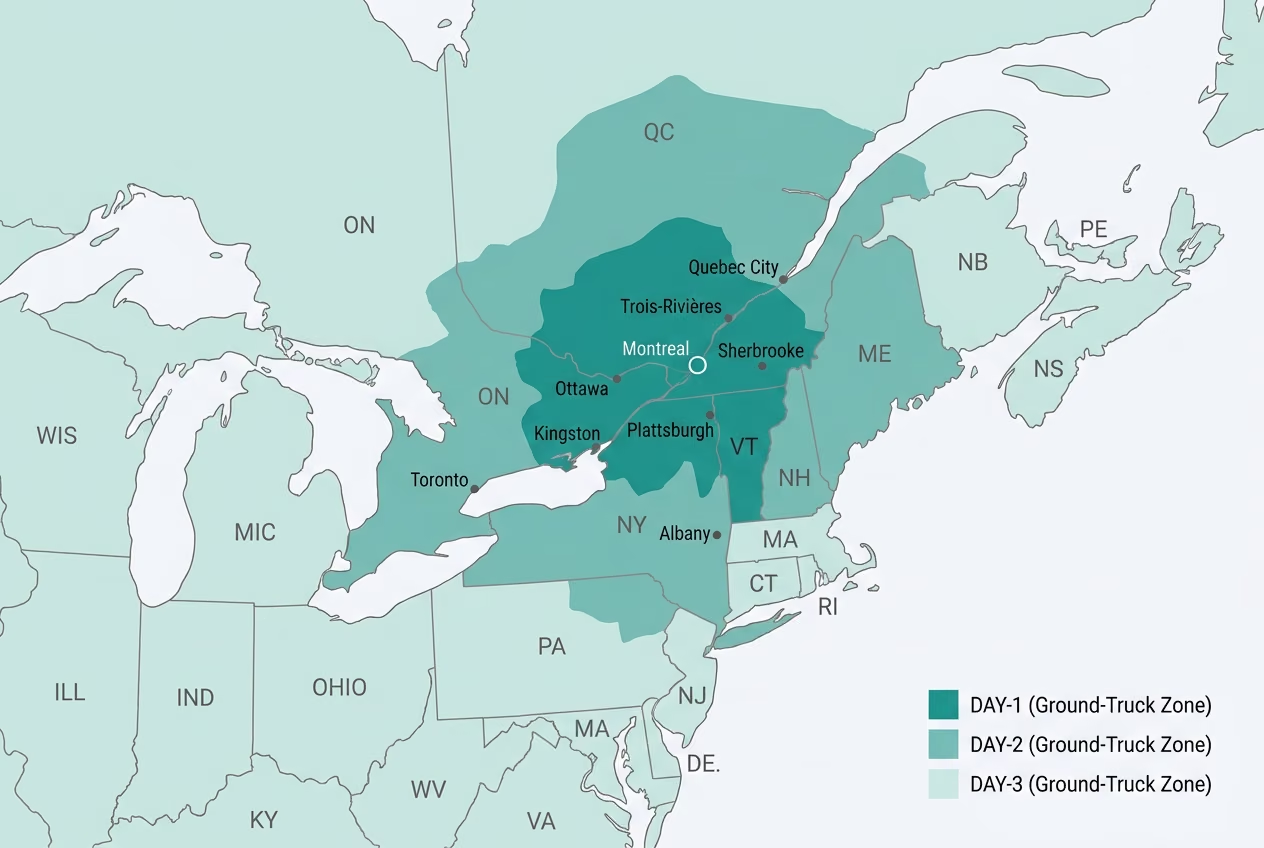
What 1-day and 2-day delivery from a Montreal 3PL actually covers
From our Montreal footprint, your inventory reaches a defined 1-day and 2-day ground zone, plus cross-border to Canada through our Canadian network. No separate Canadian 3PL setup required.
1-day delivery2-day deliveryOur Montreal facility
1d
1-day delivery
Quebec, Eastern Ontario, Atlantic Canada, New England (Boston, Burlington VT), Upstate New York
2d
2-day delivery
Most of the US Northeast and Midwest from a US warehouse in our network via the Champlain crossing, plus Ontario, Manitoba, and the Maritimes from our Montreal-area facility
XB
Cross-border to Canada
1 business day to Toronto and Vancouver via our Canadian network.
3 PM ET
Same-day cutoff
4.6M (Montreal CMA)
Metro pop served
3+
FBA codes routed
Comparison
Where in the Montreal area should your 3PL actually be?
A few honest comparisons. We're not the right fit for every brand shipping from LA, and where we're not, here's where we'd send you.
Vertex
This page
Montreal-area footprint with Bill 96 French-bilingual fluency + 10-warehouse US/Canadian network for Champlain bulk transfer
Strength
Bill 96 bilingual kitting under one roof, dual-country routing post-Section-321, 3 PM ET cutoff, CUSMA-aware SKU tagging, Amazon.ca + Amazon.com FBA prep, metro-corridor taking rate
Constraint
Best fit at 200+ orders/month with Quebec demand or US Northeast cross-border via Champlain
Best for
Canadian and US DTC brands selling into Quebec under Bill 96, with US Northeast cross-border via Champlain, Shopify + Amazon multi-channel
Bilingual French/English service is native, founder-led account management, several actively market Bill 96 bilingual labelling and Health Canada relabelling as differentiators
Constraint
Most are Canada-only (sometimes Canada + Toronto) without a structured US warehouse in our network post-Section-321; smaller carrier rate cards
Best for
Brands at sub-200 orders/month, brands needing GMP pharma cold-chain (Bulletproof specifically), or single-channel Quebec-only Shopify volume
GTA-Toronto operator with Montreal partner
Toronto-headquartered 3PL labels Montreal coverage but the actual facility is in the GTA or a partner site
Strength
National brand recognition; platform-style integrations; sales-call polish; sometimes priced lower on the Canadian-only quote
Constraint
Cannot kit Bill 96 bilingual packaging natively without a Montreal-local team; Quebec compliance bounces back to the brand; the "partner facility" Reddit warning applies
Best for
Brands who do not sell into Quebec, or brands willing to handle Bill 96 compliance entirely on their own packaging supply chain
National Canadian multi-node 3PL
Montreal is one of 10 to 12 fulfillment centers (e.g., GoBolt, Canada Post Solutions)
Strength
Dense FC network across Canada and the US; platform-style integrations; dual-country option in their stack; GoBolt joined Shopify Fulfillment Network in September 2025
Constraint
Montreal node is often partner-operated rather than company-owned; small-brand minimums (GoBolt explicitly targets 3,000+ monthly orders); less Montreal-specific operational depth on Bill 96
Best for
Brands wanting national 2-day reach across both countries via inventory split, at 3,000+ orders per month, willing to pay national-network rates
Sublease arbitrage opportunist
Short-term plays on the 2.0 MSF Amazon-Quebec sublease overhang (54% of Montreal's record 3.8 MSF sublet pool, Colliers Q3 2025)
Strength
Class A spec product at distressed pricing; Amazon-spec high-bay warehouse at a discount before the sublet overhang resets in 2027
Constraint
Short-term plays only; landlord stability and operational continuity are not the focus; usually not optimized for DTC pick-and-pack throughput or Shopify/Amazon ecommerce integrations
Best for
Bulk-storage brands or 3PL operators looking to take a 12 to 24 month bridge lease on Class A spec product before the 2027 sublet reset
Vertex pricing
Pricing for Montreal fulfillment
Pick-and-pack starts at $1.05 per DTC order. Everything else — receiving, storage, FBA prep, kitting, returns — is scoped to your SKU mix, channel set, and packout spec. Show us your current 3PL invoice and we'll tell you where we beat it, line by line.
Pick & pack
Per DTC order, standard SKU
from $1.05/order
Everything else
Receiving, storage, FBA prep, kitting, returns, multi-channel routing — quoted on a call against your real order volume and SKU profile. We do not publish a per-pallet or per-cu-ft rate sheet because the honest answer depends on what you ship.
Bring your current invoice
Already at another 3PL? Send us your last three invoices. We will reply with a side-by-side and tell you whether we can beat it. If we cannot, we will say so.
What every brand gets
Inventory sync to Shopify, Amazon, BigCommerce
Multi-carrier rate shop on every parcel
12 PM PT same-day cutoff at our Vancouver HQ
Scan-confirmed picking, not visual
No annual contract, no setup fee, no software fee
A named account lead on your account (not a ticket queue)
Bring your current invoice. We will reply with a line-by-line comparison.
FAQs about Montreal fulfillment
Real Montreal 3PL questions, answered
01 Where exactly is your Montreal warehouse?
We operate in the Montreal area as part of our 10-warehouse US and Canadian network. The actual ecommerce operations market sits in the metro corridor (Saint-Laurent / Anjou / Lachine / Boucherville) at the taking-rate band, well below downtown Montreal premiums. Our footprint is positioned for Port of Montreal drayage, YUL Montreal-Trudeau air cargo, YMX Mirabel freighter coordination, CN / CPKC rail intermodal, and the Champlain crossing to the I-87 corridor for US Northeast cross-border.
02 What is Bill 96 and why does it matter for a Montreal 3PL?
Quebec Bill 96 amends the Charter of the French Language. The packaging amendments came into force June 1, 2025, with a transition window to June 1, 2027 for products manufactured before June 1, 2025 that lacked a French trademark registration as of June 26, 2024 (McCarthy Tetrault, June 2025). Generic and descriptive terms in trademarks must appear in French regardless of trademark registration, and French must not be less prominent than any other language on packaging. Every consumer-product brand selling in Quebec needs French-language packaging. Toronto-only 3PLs can't kit this natively without bilingual labelling capabilities; we handle it on-site in our Montreal-area facility as part of the workflow, not as a separate charge.
03 How does Section 321 suspension affect my Montreal 3PL setup?
Until August 29, 2025, you could ship $800-or-less DTC parcels from Quebec directly to US customers duty-free under Section 321. That ended. Every commercial shipment to the US now requires full customs documentation and duty payment, regardless of value. CUSMA-qualified Canadian-origin goods enter tariff-free; goods that don't qualify pay applicable US duty. The credible workaround for a Montreal-based brand: bulk-import US-bound volume to a US warehouse in our network via the Champlain crossing (1 hour to NY, 5 hours to Boston, 6 hours to NYC), fulfill domestic-US from there, ship only Canada-bound parcels from our Montreal-area facility.
04 What happened with Amazon and Quebec in 2025?
Amazon Canada announced the closure of all seven Quebec facilities on January 22, 2025, laying off roughly 1,700 direct workers (NYT, AP, Washington Post; Reddit r/canada thread, January 2025). The CSN and Unifor unions filed an OECD complaint in February 2025 arguing the closure was union-busting after the CSN organized a Laval warehouse in 2024. Operationally, about 2.0 million square feet of Class A high-bay Amazon-spec warehouse hit the Montreal sublease market, which Colliers Q3 2025 reports as 54% of the record 3.8 MSF Montreal sublet pool. Direct net rents dropped 3.4% QoQ to $14.25 PSF in Q3 2025. The Class A spec product at distressed pricing is the most operationally relevant detail for any brand evaluating Montreal 3PL options in 2026.
05 What's the cutoff time for same-day shipping in Montreal?
Orders placed before 3 PM ET ship the same business day from our Montreal-area facility (Canada-bound) or a US warehouse in our network (US-bound, after the bulk transfer routing decision via the Champlain crossing). Orders after the cutoff ship the next business day. Saturday cutoffs are available on request for high-volume DTC programs.
06 Do you route inventory to Amazon FBA from Montreal?
Yes, both directions. We prep and route to Canadian FBA codes (YUL2, YUL3, YHU3) directly from our Montreal-area facility, and to US FBA codes from a US warehouse in our network, on one inventory pool with Bill 96 French-labelled SKU variants tracked separately. FBA labeling, polybagging, and inbound shipment plans are included on both Amazon.ca and Amazon.com. We re-validate FNSKUs on a recurring cadence so spec changes do not cause inbound rejections.
07 Do you support Port of Montreal and YUL / YMX air cargo inbound?
Yes. Port of Montreal handled 1.52M TEU in 2025 (+3.6% YoY, Montreal Port Authority annual report 2026), with the $1.16B Contrecoeur expansion (Canada Infrastructure Bank loan, DP World Canada operator) adding 1.15M TEU annual capacity by 2030. We dray from the port to our Montreal-area facility in 12 miles. YUL Montreal-Trudeau moved 158,020 metric tonnes of air cargo in 2024 with 156 direct destinations (Transport Canada, ADM Aeroports de Montreal). YMX Mirabel is Canada's dedicated 24/7 all-cargo airport on 4,400 hectares with one of Canada's longest runways (12,000 ft x 200 ft) and no operating restrictions.
08 What is the Port of Montreal labor risk?
Port of Montreal lost 10 days to the November 2024 CUPE Local 375 lockout: 1,200 longshoremen, partial strikes Q4 2024, full lockout November 10 through 13, binding arbitration ordered November 12, 2024 by Labour Minister Steven MacKinnon, with $930M/day of cargo affected across simultaneous Montreal and Vancouver lockouts (Al Jazeera, Reuters). The CIRB ruling rules out future strikes until the next CBA expiry. We hold pre-booked drayage windows at multiple terminals and run a written contingency plan that includes rail-out-of-Halifax and YMX Mirabel air cargo as backup lanes. Canada Post separately ran a 32-day CUPW strike in late 2024 that pushed Canadian e-commerce down 30 to 40 percent year-to-date by some estimates; we default-route through Purolator, UPS Canada, and FedEx with Canada Post as a flagged fallback.
09 How do you handle CUSMA classification?
We do not certify origin; your customs broker does. What we do is tag every SKU at receipt against your broker's CUSMA certification and route qualifying SKUs separately from non-qualifying ones, so you do not pay duty on goods that should ship duty-free. For apparel and consumer goods with non-North-American inputs, we coordinate with your broker on the per-SKU classification at onboarding.
10 Do you operate a CBSA-licensed bonded sufferance warehouse?
No. We are not a CBSA sufferance or bonded facility. For brands needing high-volume duty-deferred storage (up to 4 years), tariff-cycle release timing, or re-export plays, we refer to specialists. For most brands, the bonded overhead does not pay back; the dual-country bulk-import model we run via the Champlain crossing is usually the cleaner answer.
11 What is the minimum order volume to work with Vertex in Montreal?
We work best with brands shipping 200+ orders per month, ideally with Quebec demand (Bill 96 applies) or US Northeast cross-border via the Champlain crossing to justify the dual-country infrastructure. Below 200 orders per month, smaller Montreal-only operators (Bulletproof Logistics, Shiporo, 3DM Logistics, TSPM Entrepot, Precise Warehousing in Baie-d'Urfe, Boutin 3PL in Boucherville) will beat us on cost; we say so on the discovery call.
12 I do not sell into Quebec. Should I use your Montreal facility?
Probably not. The Bill 96 bilingual-kitting differentiator disappears for non-Quebec SKUs, and our /locations/canada/ontario/toronto-3pl page is the smarter geography for Canadian DTC in a tighter, larger 850 MSF GTA market (Cushman & Wakefield Q1 2026). We will say this on the discovery call rather than sell you a geography that does not fit.
13 How long does onboarding take?
Standard onboarding runs 1 to 2 weeks: discovery call, integration setup (Shopify, Amazon.ca, Amazon.com, your ERP), Bill 96 French-packaging spec review with your trademark counsel, CUSMA-tagging review with your customs broker, SOP design, and first inbound receiving. Brands with clean SKU data, a single sales channel, and Bill 96 + CUSMA classifications already documented can be live in under a week.
14 Do you require an annual contract?
No. We use service agreements, not contracts. You can pause, scale up or down, or move volume across our nodes (our 10-warehouse US and Canadian network) without penalty. Termination is 60 days written notice.
Get a custom quote in 24 hours, based on your SKU mix, order volume, and Eastern Canada delivery needs. 3 PM ET cutoff. 24-hour receipt-to-pickable. No annual contract.