Amazon FBA Prep

Amazon FBA Prep Services

Per-unit FBA prep — labels, polybags, bundles, expiration, carton, ship-to-FBA — done before your shipment leaves our dock.

from $1.05
Pick + pack per order
5 days
Sign to first parcel ships
4 PM PT
Same-shift cutoff (Vancouver HQ)
Custom
Quote on everything else

The official program

What FBA Prep actually is in 2026

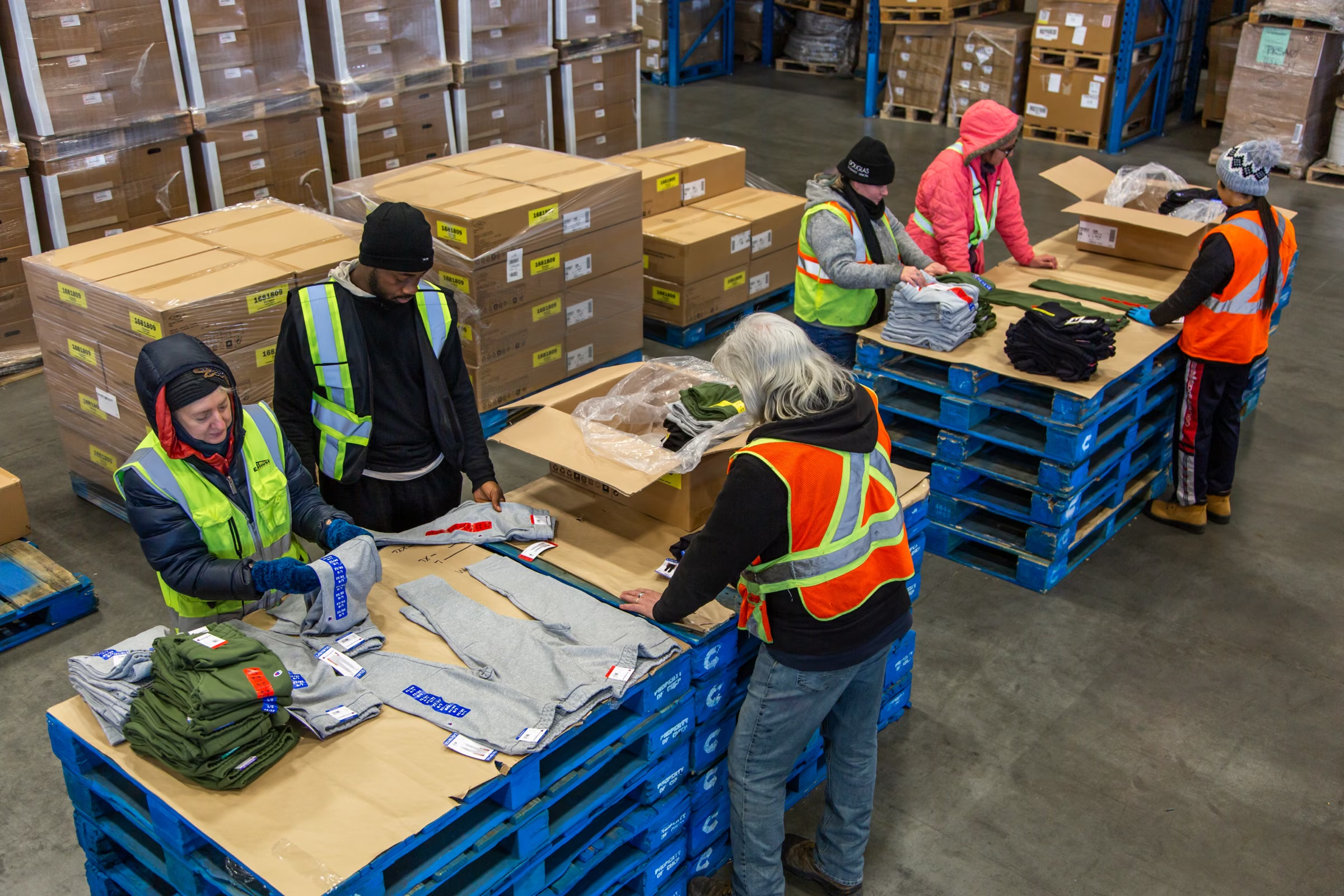
FBA Prep is the work that has to happen before your inventory can ship to Amazon's fulfillment centers. Amazon publishes a specification for how every unit must be labeled, packaged, sealed, dated, and palletized before it arrives at an FBA receiving dock. Units that fail prep get rejected, downgraded to unfulfillable, or destroyed at your cost. Amazon does not negotiate.

The Amazon prep spec covers FNSKU label placement and barcode quality, polybag thickness (minimum 1.5 mil) and suffocation warning placement, expiration date format (mm/dd/yyyy, 90+ days at receipt for consumables), bundle and multi-pack stickering, carton weight and dim limits, and pallet build standards. The full spec runs roughly 60 pages and gets revised quarterly. Most brands cannot keep up internally and outsource prep to a 3PL.

FBA Prep is also where most 3PLs make their money and most brands lose theirs. Industry rejection rates at FBA receiving can run several percent across third-party prep providers. A high rejection rate on a six-figure Q4 inbound means dead inventory plus reshipment cost plus Performance Notification risk on your seller account. We run an 8-station prep workflow with verification at every station, not a 3-step workflow that hopes for the best.

What Vertex does for FBA Prep

The 8-step prep workflow we run on every unit

Click any step below to see exactly what we verify at that station. Every unit clears all eight stations before the carton leaves our floor for FBA.

01

Step 1 of 8

Receive

Inbound freight arrives at our dock. We photograph pallets on arrival, count cases against the BOL, and flag damage in writing before the driver leaves.

What we check at this station

  • Pallet photographs before unloading
  • Case count vs BOL reconciled at the dock
  • Damage exception filed against carrier if needed
  • ASN matched to inbound Seller Central shipment plan

Amazon's bar

What Amazon's FBA prep spec actually requires

The non-negotiables from Amazon's prep spec. The prep line is built around these requirements.

FNSKU on every unit

Amazon FNSKU (Fulfillment Network Stock Keeping Unit) label applied over the manufacturer barcode or on a poly bag that covers it. Without the FNSKU, FBA receiving has no way to associate the unit with your seller account. The label must be scannable at 203 dpi minimum and fully cover any conflicting barcode.

1.5-mil minimum polybag thickness

Polybags must be at least 1.5 mil thick. Thinner bags rip in transit, leak in the FBA receiving lane, and trigger rejections. The bag must be transparent enough for Amazon to scan the FNSKU through the bag.

Suffocation warning on bags over 5 inches

Any polybag larger than 5 inches per side requires a printed suffocation warning in English, with at least 5-point font, on the bag itself. Stickers do not count; the warning must be printed into the bag at manufacture.

90+ days shelf life at FBA receipt

Consumables (food, supplements, beauty, vitamins, pet food) need at least 90 days of remaining shelf life at the time of receipt at the FBA node. Date format is strictly mm/dd/yyyy, printed in 36-point font minimum, on the outer carton label.

Single FNSKU on bundles and multi-packs

Bundles and multi-packs ship under one new FNSKU representing the bundle as a single ASIN. A "Sold As Set" sticker on the outer pack prevents Amazon receiving from splitting the bundle into individual units. Inner units inside a bundle do not get individual FNSKU labels.

Carton weight + dim limits

Standard FBA cartons under 50 lbs and under 25 inches on the longest side. Cartons over 50 lbs need a "Team Lift" sticker; over 100 lbs need a "Mech Lift" sticker. Cartons that exceed both weight and dim limits get rejected at receiving and reshipped at your cost.

The honest list

The five FBA receiving rejections we prevent

The five most common reasons Amazon rejects FBA shipments at receiving, and exactly how our 8-step workflow catches each one before the shipment leaves our floor.

01

Missing or wrong FNSKU

Amazon receiving cameras scan the FNSKU and match against the inbound shipment plan. A missing FNSKU or one that maps to a different ASIN sends the unit to the "unfulfillable" queue, sometimes for weeks. We scan-check every unit against your shipment plan before it leaves the floor.

02

Polybag too thin or no suffocation warning

FBA requires a minimum 1.5-mil polybag with a printed suffocation warning visible from the outside, on every bag larger than 5 inches per side. Thin bags and bags without warnings get rejected at the FBA node and trigger a Performance Notification on your account. We stock 1.5-mil bags only.

03

Expiration date inside the 90-day window

Consumables (food, supplements, beauty, vitamins) need at least 90 days of shelf life at the time of receipt at the FBA node. Anything shorter gets destroyed at your cost. We catch expired or near-expired stock at our receiving dock and quarantine before prep starts.

04

Bundle sold as separate units

Multi-packs and bundles need a single FNSKU treating them as one ASIN, plus a "Sold As Set" sticker. Missing the sticker means Amazon receivers split the bundle into singles and your bundle ASIN goes out of stock. We sticker every bundle at prep time.

05

Carton over weight or oversize

FBA cartons over 50 lbs need a "Team Lift" sticker; over 100 lbs need a "Mech Lift" sticker. Oversize cartons trigger surcharges or rejections. We weigh and dim every carton and apply weight stickers automatically when thresholds trip.

FBA Small and Light edge cases

FBA Small and Light is the sub-program for low-weight, low-retail units. The pick-and-pack fee is meaningfully cheaper per unit than standard FBA, but the prep spec is stricter on a few points: weight verification at the prep station, retail price check against Seller Central, and an explicit Small and Light routing flag in the shipment plan. We run Small and Light as a prep variant on the same line: same FNSKU, same polybag, plus weight verification at the prep station and a Small and Light routing flag in the outbound shipment plan. If your average ticket sits at low retail with low-weight units, Small and Light is usually the right FBA variant.

FBA Prep pricing at Vertex

Transparent FBA prep pricing

What FBA prep covers at Vertex. Pricing scoped to your unit count and prep workflow on the discovery call. No setup fees, no per-SKU charges, no scorecard fees.

Standard FBA Prep

Per unit

scoped on call

Full 8-station workflow on every unit: receive, verify, FNSKU, polybag, bundle, expiration, carton, ship. Bulk pricing on higher monthly volumes.

Bundle / multi-pack

Per bundle

scoped on call

Hand-assembly of bundles and multi-packs, single outer FNSKU, Sold As Set sticker, bundle pack-out. Each inner unit counts toward bundle cost (not as individual prep).

Inbound receiving

Per pallet

scoped on call

Receive, photograph, count vs BOL, ASN-match to your Seller Central shipment plan. Invoiced once at receipt, not monthly.

Storage for FBA reserve inventory bills per pallet position or per cubic foot of shelf storage and gets scoped on the discovery call. Inbound to FBA freight bills at your Amazon Partnered Carrier rate or your preferred LTL carrier rate, pass-through. AWD coordination on top of standard FBA prep is no separate charge.

Where we run FBA Prep

Prep nodes positioned for the right FBA assignments

Amazon assigns FBA receiving nodes based on the origin of your inbound shipment. A prep node in the right region cuts your inbound freight cost and reduces the chance Amazon splits your shipment across multiple FBA warehouses. We run prep out of nodes that map cleanly to the major FBA receiving clusters.

Northeast

Newark + New Jersey

Feeds FBA Northeast cluster (ABE8, EWR4, PHL7) on 1-day LTL.

Southeast

Atlanta

Feeds FBA Southeast cluster (ATL6, MGE5, CHA2) on 1-day LTL.

Midwest

Chicago + Indianapolis

Feeds FBA Midwest cluster (MDW2, MDW6, IND9) on 1-day LTL.

South Central

Dallas + Houston

Feeds FBA Texas cluster (DFW7, FTW1, HOU3) on 1-day LTL.

West

Los Angeles + Inland Empire

Feeds FBA West cluster (LGB8, ONT8, SBD1) on 1-day LTL.

Toronto + Vancouver

Canadian FBA prep

Feeds FBA Canada (YYZ7, YVR4) for CUSMA-qualified Canadian-origin goods routed differently than non-CUSMA inbound.

Ready for FBA prep that holds the spec?

Talk to our FBA prep team

Eight prep stations on every unit. Receipt-to-inbound on an agreed cadence. Per-unit prep pricing scoped on the discovery call. No annual contract, no setup fees.

Talk to our 3PL team

Custom quote in 24 hours.

Tell us what you ship and where your customers are. We respond from a human address inside one business day. No mailing list.

We reply from a human address. No drip sequence, no mailing list.