Marco, Kim, Tom & Sara
· Receiving, Pick & Pack, FBA Prep, Account Management
Last reviewed by our team on May 10, 2026 against current CBRE San Antonio + Laredo CBP + FTZ #80 / #96 data.
Most brands shopping for a 3PL in San Antonio think the value is "Military City" or "near the Alamo." That misses the actual story. San Antonio is the only US metro 2 hours from BOTH Laredo (~$800B / 35% of US-Mexico trade) AND Eagle Pass ($43.75B, fastest-growing US crossing), and your 3PL is actually in Schertz, Selma, or New Braunfels, never the 78201 zip.
Layer that over Toyota's $10B manufacturing ecosystem, JCB's $500M / 1,500-job plant opening October 2026, Sanko Texas plastics, Microsoft data centers in Medina County, FTZ #80 at the 1,900-acre Port San Antonio, and full Triple Freeport status (Bexar County + City + Judson ISD + SAISD), and San Antonio is a different value proposition from Houston port-adjacent or Austin tech-adjacent 3PLs.
We operate from the San Antonio area as part of our 10-warehouse US and Canadian network. This page covers what we ship from where, what we charge, where we win, and where we send you to a competitor.
Key takeaways
1
San Antonio is the only US metro within a 2-hour drive of both Laredo (~$800B / 35% of all US-Mexico trade) and Eagle Pass ($43.75B in 2024, fastest-growing US border crossing). The I-35 corridor through San Antonio is the only highway touching both crossings plus the Austin / DFW manufacturing pipeline.
2
Every "San Antonio 3PL" is actually in Schertz, Selma, New Braunfels, or the Southside Toyota corridor. We operate from the San Antonio metro area with full Triple Freeport status (Bexar County, City of San Antonio, Judson ISD, and SAISD all opted in) and FTZ #80 fluency at Port San Antonio for tariff-deferral routing.
3
Partners Real Estate Q4 2025: 11.3 percent industrial vacancy (Q3 hit 11.5 percent, a historical high), W/D rents materially below Austin and Houston at the same spec, 686K SF Q4 absorption, deliveries collapsed 91 percent QoQ. This is a tenant's market. SAT cargo hit 274.8M lbs in 2025 (+15.7 percent YoY, all-time record). Amazon SAT1 Schertz = 1.26M SF (Hines $129.2M).
4
We fit brands shipping 500+ DTC orders per month with Texas Triangle, Mexico-nearshoring, or Toyota-supplier-adjacent kitting / co-pack demand. Below 200 orders per month, smaller in-SA boutiques beat us on cost. Cold-chain freezer pharma goes to Houston. Brands needing only DFW reach should use our Dallas page. We say so on the discovery call.
Why San Antonio
Why San Antonio is the only US metro 2 hours from both Laredo and Eagle Pass
Laredo + Eagle Pass land borders (2hr south). Together ~$800B / 35% of US-Mexico trade, with Eagle Pass the fastest-growing US crossing.
San Antonio is the only US metro that sits inside a 2-hour drive radius of both Laredo and Eagle Pass. Laredo handled ~$800 billion in US-Mexico trade in 2025 (~35% of all US-Mexico binational trade, 20,000 commercial truck crossings per day per Pro Texas Industry and Lee & Associates). Eagle Pass cleared $43.75 billion in 2024 ($30.48B imports + $13.27B exports) and is the fastest-growing US-Mexico crossing, with March 2026 alone running $3.77B (FreightWaves, eaglepasstx.gov). Per BTS Transborder Annual Report, US-Mexico trade hit $872.8B in 2025 (+3.9% YoY), with trucks carrying 73.6% of total value. We are 156 miles / 2 hours 14 minutes south of Laredo on I-35, and 143 miles / 2 hours 46 minutes southwest of Eagle Pass on US-57. No other US metro touches both crossings inside that radius. The I-35 NAFTA corridor through San Antonio is one of the busiest interstate stretches in the country (~19,439 truck trips per day on the SA-Austin segment per TxDOT, 3rd-most-congested US Interstate for trucks). For brands routing finished goods from Monterrey, Saltillo, or Guanajuato, San Antonio is the cross-dock point.
The honest geography buyers are not told: virtually no "San Antonio 3PL" Google result is inside San Antonio city limits. The real warehouse nodes are Schertz (Amazon SAT1 anchors the I-35 corridor with 70+ distribution companies in city limits), Selma (Exeter's 307,250 SF Selma Industrial Park leased to Berlin Packaging, Westport Axle, and Made in Cookware), Cibolo / Live Oak / Universal City (Loop 1604 NE crescent), New Braunfels (Comal County, Sysco regional DC), and the Toyota-anchored Southside corridor.
We operate from the broader San Antonio metro. Triple Freeport (Texas Tax Code 11.251) zeros out state inventory tax on goods leaving Texas within 175 days, and Bexar County, the City of San Antonio, Judson ISD, and SAISD have all opted in. Every SKU that turns inside 175 days carries zero state inventory tax, a structural margin advantage Austin and Houston do not match on equivalent NNN rates.
San Antonio industrial vacancy sits at 11.3 percent (Q3 hit 11.5 percent, the historical high), with W/D rents materially below Austin and Houston at the same spec. 2025 was a tenant's market.
SA is winning the Toyota-adjacent nearshoring race: Toyota TMMTX, JCB $500M / 1,500 jobs opening October 2026, Sanko Texas $40M / 300 jobs supplying Toyota, Microsoft $1.4B across 4 Medina County data centers, and Lefko USA $15M in New Braunfels. SAT cargo hit 274,847,470 lbs in 2025 (+15.7 percent YoY, all-time record).
Port San Antonio (1,900 acres former Kelly AFB) houses 80+ tenants, 19,000 employees, contributed $10.6B to Texas GDP in 2024, and the full campus is FTZ #80-10. Use Eagle Pass FTZ #96 for the southwest crossing. This is the structural cost arbitrage window.
What it unlocks
What a San Antonio 3PL gets you that a Midwest 3PL can't
We operate in the San Antonio area as part of our 10-warehouse US and Canadian network, positioned for SAT (San Antonio International) air cargo, the I-35 NAFTA corridor south to Laredo, US-57 southwest to Eagle Pass (FTZ #96), I-10 east to Port Houston, and the SA-Austin "Austonio" supercluster on I-35 north. Inside full Triple Freeport jurisdiction (Bexar County, City of San Antonio, Judson ISD, and SAISD all opt in to the 175-day rule).
01
Laredo + Eagle Pass cross-border
San Antonio is the only US metro 2 hours from both Mexican crossings. Laredo handled ~$800B in 2025 (35% of all US-Mexico trade); Eagle Pass cleared $43.75B in 2024 and is the fastest-growing US crossing. We run DDP / DDU to Monterrey, Saltillo, and Mexico City via Estafeta and DHL Express Mexico, and coordinate FTZ #96 (Eagle Pass / Maverick County) routing.
02
Triple Freeport + FTZ #80 stack
Bexar County, the City of San Antonio, Judson ISD, and SAISD have all opted into Texas Tax Code 11.251, so every SKU that turns inside 175 days carries zero state inventory tax. We coordinate with FTZ #80 (City of San Antonio, grantee since 1982; Port SA campus FTZ #80-10) for brands where direct duty deferral pays back the overhead.
03
Schertz / I-35 rent arbitrage
Partners Real Estate Q4 2025 reports SA industrial vacancy at 11.3 percent (Q3 hit 11.5 percent, a historical high), W/D rents materially below Austin and Houston on equivalent space, 686K SF of Q4 absorption. We hold capacity in Schertz and Selma at the regional W/D rate.
04
Toyota / Sanko / JCB ecosystem
TMMTX runs 3,700+ direct employees + 20 on-site suppliers + 30+ near-plant suppliers ($10B 10-year economic impact). JCB opens Oct 2026 ($500M / 1M SF / 1,500 jobs). Sanko Texas ($40M plastics, 300 jobs, supplies Toyota). Microsoft 4 Medina County data centers ($1.4B). SAT cargo 274.8M lbs in 2025 (+15.7% YoY, all-time record). Deep labor and carrier capacity year-round.
For Shopify brands
Should Shopify store owners have a 3PL in San Antonio?
A San Antonio 3PL is the right call for a Shopify brand when Mexico nearshoring (Laredo OR Eagle Pass), Toyota-supplier-adjacent kitting / co-pack, the SA-Austin "Austonio" supercluster (90 minutes to Austin), or Triple Freeport tax savings on Texas Triangle distribution matters most. Houston is the right call when Gulf Coast inbound or FTZ #84 petrochemical-scale duty deferral is the priority. Dallas is right for DFW air-cargo dominance or AllianceTexas. Below 200 monthly orders, a San Antonio 3PL almost never pencils out, and a smaller in-SA boutique will beat us on cost.
Yes if
You import or export via Mexico AND you want optionality on the crossing. We are 2 hours from Laredo (~$800B / 35% of US-Mexico trade, the world's largest land port) AND 2 hours from Eagle Pass ($43.75B in 2024, fastest-growing US crossing). No other US metro touches both inside that radius. We run DDP / DDU to Monterrey, Saltillo, and Mexico City via Estafeta or DHL Express Mexico.
Texas Triangle, Central US, or Mexico-bound demand accounts for 50% or more of your orders. From our San Antonio-area facility, all of Texas plus LA, OK, AR, NM, and most of MS sits in 1-day ground; San Antonio is 1.5 hours from Austin (the SA-Austin "Austonio" supercluster) and 3 hours from Houston.
You want Triple Freeport tax savings. Every SKU that turns inside 175 days carries zero state inventory tax under Texas Tax Code 11.251. Bexar County, the City of San Antonio, Judson ISD, and SAISD have all opted in.
You need kitting, co-pack, or B2B-component flow alongside DTC. The Toyota TMMTX ecosystem (3,700+ direct employees, 20 on-site suppliers, 30+ near-plant suppliers, $10B 10-year economic impact, Sanko / JCB / Lefko USA all stacked in 2026), Microsoft's 4 Medina County data centers, and Port San Antonio's aerospace cluster mean SA labor and inbound carrier capacity skew manufacturing-DTC hybrid, not pure pick-and-pack.
You ship 500+ DTC orders per month. Below that, smaller in-SA boutiques and match-services (Fulfill.com, Third Person, WareMatch) beat us on price.
No if
Your demand is heavily Northeast or Pacific Northwest. Shipping from San Antonio adds Zone 5 to 7 surcharges to most of those parcels. We can split inventory across our SA + LA + East Coast nodes, but if you want a single-node setup, an LA or Philadelphia operator is cheaper.
Cold-chain fulfillment (frozen or refrigerated). Our San Antonio-area facility runs ambient-only. Cold-chain freezer pharma belongs in Houston (cold-chain tier operators) or with a GMP-certified specialist.
You only need DFW reach. Use our Dallas page; AllianceTexas and DFW air-cargo dominance are the better lanes.
You only need Port of Houston port drayage. Use our Houston page; Bayport / Barbours Cut and FTZ #84 are the right answers.
You need Mexico nearshoring without a Texas operation. Use our Phoenix page (Sonora / Baja California crossings) or our San Diego page (Tijuana / Otay Mesa) depending on the Mexico region.
Sub-200 orders per month. The SA market is loose (Partners Q4 2025: 11.3 percent vacancy, a historical high, W/D rents below Austin and Houston), and a smaller in-SA boutique 3PL will run cheaper at your volume than our cost floor.
If "yes" lands on you, the next question is which Shopify-side workflow tests separate ops-grade San Antonio 3PLs from ones that look good on a sales call. Six questions to ask any operator below.
Workflow
What should happen
What usually breaks
Question to ask
New order arrives
In the pick queue near real time
Polling intervals over 5 minutes; orders missed during peak
How often does your sync run, and what is the worst-case lag?
Inventory level changes
Pushes back to Shopify in real time
Daily batch updates → oversells during peak hours
Is inventory sync push or pull, and at what frequency?
Tracking number written
Posts to Shopify the moment carrier scans
Manual upload at end of day; customer emails arrive late
When exactly does tracking hit Shopify?
Pre-order / backorder
Order holds, ships when stock arrives
Order silently fails or ships partial without notice
How does your WMS handle backorders without losing the customer relationship?
Returns refund trigger
Refund triggers on return scan-in (or on inspection pass)
Returns sit unprocessed for days, customer service workload
What event triggers the refund: receipt, inspection, or restock?
Subscription orders
Routed separately, with subscription-specific packouts
Sub orders treated as one-time DTC, no recharge protection
How do you tag and prioritize Recharge / Skio subscription orders?
For Amazon FBA brands
Should Amazon FBA brands have a 3PL in San Antonio?
A San Antonio 3PL alongside Amazon FBA gets specific value when you want first-port prep before routing to Amazon's SA-area fulfillment centers (SAT1 Schertz 1.26M SF, SAT2 San Marcos, SAT5). Pure FBA-only domestic-supplier brands rarely need it.
Yes if
You import via Laredo, Eagle Pass, or Houston and want a Texas Triangle deconsolidation point before FBA routing. We receive containers via Laredo I-35 cross-border, Eagle Pass US-57 cross-border, or I-10 truck-in from Port Houston, polybag and FNSKU-label inside 24 hours, and route to SAT1 / SAT2 / SAT5 the same week.
You sell on Amazon AND Shopify (or DTC). FBA does not handle your DTC orders. We do both from one inventory pool.
You want to throttle FBA storage during slow seasons. We hold overflow inside Triple Freeport jurisdiction (zero inventory tax inside 175 days) and re-route to FBA when demand returns, sidestepping FBA long-term storage fees.
You want to skip Amazon's prep markup. Our San Antonio prep is quoted per unit against your real polybag, FNSKU, and bundle scope, and typically beats Amazon's prep service fees on the same SKU set. Note the Reddit signal from current Amazon SAT1 Schertz operators: peak hiring runs ahead of Prime in June, which tells you the labor pool depth is real.
No if
100% Amazon FBA, no other channel. If you do not run DTC or wholesale, going direct to FBA from your supplier (with Amazon Global Logistics or a freight forwarder) is usually cheaper than adding a 3PL leg.
Domestic suppliers in the Northeast or Midwest. If your inventory ships from a NJ or OH factory, the San Antonio cross-border / Triple Freeport advantage does not apply. A regional 3PL closer to your supplier saves freight.
You do not import in container quantities. LCL or air-freight import volumes do not generate enough Triple Freeport or cross-border savings to justify the San Antonio operating cost.
Most multi-channel Amazon sellers with Texas Triangle demand or Mexico nearshoring routes benefit from a San Antonio 3PL specifically because Triple Freeport zeros out inventory tax inside 175 days and Laredo / Eagle Pass crossings give you optionality on which border the inbound flows through.
Scope
What a San Antonio 3PL should and shouldn't handle
A common mistake brands make when scoping a San Antonio 3PL is treating it as a generic warehouse. Warehouses store things. A 3PL is closer to an operations team that happens to live in a warehouse. Knowing the line between what we own and what stays with your team prevents the most common onboarding fights.
✓ The 3PL owns
Receiving inbound via SAT air cargo, Schertz / I-35 truck consolidation, Laredo cross-border land freight, Eagle Pass cross-border via US-57, or Houston port drayage on I-10 (3 hours east)
Storing inventory in racked, lot-tracked, FIFO-rotated locations inside Triple Freeport jurisdiction (175-day rule, Bexar County + City of San Antonio + Judson ISD + SAISD all opted in)
Picking, packing, and shipping DTC orders against a 2 PM CT same-day cutoff
Routing inbound shipments to Amazon FBA Texas centers (SAT1 Schertz, SAT2 San Marcos, SAT5)
FNSKU re-validation and FBA spec updates so Amazon does not reject your inbound
Cross-border to Mexico shipping (DDP / DDU) via I-35 NAFTA to Laredo or US-57 to Eagle Pass for Monterrey, Saltillo, and Mexico City customers
FTZ #80 (Port San Antonio) and FTZ #96 (Eagle Pass / Maverick County) routing coordination with partner brokers for brands where the tariff math justifies the overhead
Toyota-supplier-adjacent kitting, co-pack, and B2B-component flow alongside DTC from one inventory pool
Returns receiving, inspection, restocking or disposition per your written rules
Cycle counts and quarterly physical inventory
EDI-compliant retail outbound (856 / 940 / 810) for Shopify B2B and Texas retail accounts
✗ The brand owns
Demand planning and reorder timing. You own this; we feed the data.
Customer service and chargebacks. We feed tracking and exception data; your CX team handles the conversation.
Marketing copy on packing slips and inserts. You supply the artwork; we apply it.
Carrier rate negotiation. You can use your own carrier accounts; we route to whichever rate card you supply.
Custom packaging design. Bring the spec; we execute the packout.
Cold-chain freezer or refrigerated fulfillment (pharma, food, beauty cold storage). Our San Antonio-area facility runs ambient-only. We refer cold-chain brands to GMP-certified Houston operators.
Foreign Trade Zone (FTZ) duty deferral inside our four walls. We are not a designated FTZ ourselves. For brands where the tariff math justifies the overhead, we coordinate with FTZ #80 (Port San Antonio, OpTech-managed public FTZ; Boeing and StandardAero subzones), FTZ #96 (Eagle Pass / Maverick County), or partner brokers.
Aerospace MRO, defense-depot work, or engine-core refurbishment. That is Boeing and StandardAero territory at Port San Antonio. We ship the finished good; we do not maintain aircraft.
Order flow
Inside a San Antonio 3PL: 10 steps from SAT cargo or Schertz / I-35 truck to porch
San Antonio does not have a deepwater port. Inbound is Laredo or Eagle Pass land border on I-35 / US-57 (2 hours south), SAT air cargo, or Houston Port drayage on I-10 (3 hours east). Once a shipment clears CBP or the air-cargo handler, the truck moves the cases to our Schertz / Selma / New Braunfels industrial cluster and the customer parcel scans on their porch from there. Here is the exact path. Ten steps, mapped to who does what and where the typical 3PL drops the ball.
01
Inbound notice
Your supplier or freight forwarder sends an ASN (Advance Shipping Notice) or simple email with PO, expected SKUs, container or pallet count, and ETA. We pre-allocate a receiving dock window in Schertz / Selma.
What is this?
An ASN is a structured file (EDI 856 or our standard CSV / spreadsheet) that lists every SKU, expected quantity, container or pallet ID, and ETA before the freight arrives. With an ASN, our receiving team pre-prints labels, pre-assigns rack locations, and starts unload the moment the truck checks in. Without an ASN, every container takes 2 to 4 extra hours because we have to reverse-engineer the shipment on the dock. We accept both EDI and a simple template if your supplier is small.
02
Truck or air-cargo arrival
Inbound arrives at our San Antonio-area facility via SAT air cargo trans-load, Laredo cross-border truck on I-35, Eagle Pass cross-border truck on US-57, or Houston Port drayage on I-10 (3 hours east). Driver checks in, dock door is assigned, unload begins.
What is this?
San Antonio does not have a deepwater port. Inbound is SAT air cargo (274,847,470 lbs handled in 2025, +15.7% YoY all-time record), Laredo land-border cross-docking (156 miles / 2 hours 14 minutes south on I-35 NAFTA, ~$800B in 2025 trade), Eagle Pass land-border cross-docking (143 miles / 2 hours 46 minutes southwest on US-57, $43.75B in 2024, fastest-growing crossing), or Houston Port drayage on I-10 (197 miles east, 3 hours). All four modes hit the same dock; the WMS just receives them differently. For brands routing Mexico-finished goods from Monterrey or Saltillo, the I-35 NAFTA corridor delivers Laredo-cleared trucks to our dock the same day.
03
Receive + count
Cases are unloaded, scanned, counted against the ASN. Discrepancies (short / over / damaged) are flagged and photo-documented inside 24 hours.
What is this?
Every case gets a barcode scan against the ASN line item. If the count matches, the SKU moves to putaway. If it does not (short ship, over-ship, damaged outer), our team photo-documents the variance with timestamps and dock-door ID, then logs it in our exception queue. You get an email within 24 hours with the photos, the variance, and our recommended next step (claim with carrier, request supplier credit, accept and adjust on-hand). For cross-border inbound, the CUSMA / USMCA certificate-of-origin filed at receipt feeds your customs broker for audit defense.
04
Putaway
SKUs are binned to designated rack or floor locations using our WMS inside Triple Freeport jurisdiction. Lot codes and expiry dates captured at this step for food / supplements / beauty SKUs.
What is this?
Putaway is the act of moving received cases from the dock to a permanent rack or floor location. Our WMS assigns the location based on velocity (fast-movers near the pack table, slow-movers in deep storage), pallet height, and lot rotation rules. Because we sit in Triple Freeport jurisdiction (Bexar County, City of San Antonio, Judson ISD, and SAISD have all opted in), every SKU that turns inside 175 days carries zero state inventory tax under Texas Tax Code 11.251. We tag inventory on receipt with the 175-day clock so you can see which units are inside the freeport window in your monthly report.
05
Order sync
A good WMS pulls orders from Shopify, Amazon, BigCommerce, and your ERP near real time. New orders appear in the pick queue automatically. We run Datex Footprint for this.
What is this?
Order sync is the live link between your sales channels and our pick queue. A good WMS polls Shopify, Amazon Seller Central, BigCommerce, and ERP systems frequently so the order is in the pick queue shortly after checkout. We run Datex Footprint for this. Inventory levels push back to your store when the pick is confirmed, which prevents oversells during traffic spikes.
06
Wave release
Orders are batched into pick waves based on carrier cutoff time. DTC same-day orders run first, B2B and retail run second.
What is this?
A wave is a batch of orders released to the floor as a single pick task. We organize waves by carrier sweep time (UPS at 4 PM, FedEx at 5 PM, USPS at 5:30 PM CT) and by service level. DTC same-day orders run in the first wave because their cutoff is tightest. B2B and retail outbound run in later waves where the carrier sweep is later. This sequencing keeps small fast orders from waiting behind a large pallet pick.
07
Pick
Pickers scan each item against barcode and bin location. A good WMS rejects mispicks before they reach the pack table. That is how an operator holds pick accuracy in the high-nineties consistently.
What is this?
Picking is the moment a worker grabs the right SKU off the shelf for an order. A good WMS forces a barcode scan at every pick, comparing the scanned SKU against the order line. If they do not match, the system blocks the pick and routes the worker back to the correct bin. That double-check is what keeps a 3PL at high-nineties shipped-correct accuracy across high order volumes.
08
Pack + label
Packers select carton, add inserts, generate carrier label, weigh, and tape. Each pack table runs a triple-check process before the parcel leaves the station.
What is this?
At the pack station, the worker selects the right-size carton (we calculate dim weight to keep your shipping costs low), adds any inserts (thank-you cards, samples, marketing flyers you supply), prints the carrier label, weighs the parcel, and tapes. Three checks happen before the parcel leaves: SKU match, label match, and weight sanity check. If any fail, the parcel goes to a re-pack station before it ships.
09
Carrier handoff
Parcels stage by carrier (UPS, FedEx, USPS, DHL, Estafeta for Mexico, Canada Post via our Canadian network). Carrier sweeps happen at fixed daily windows. Tracking pushes back to Shopify and Amazon automatically.
What is this?
Parcels stage in carrier-specific zones near the loading dock. UPS, FedEx, USPS, DHL, our Mexico cross-border partner (Estafeta or DHL Express Mexico, depending on rate card), and Canada Post (via our Canadian network) each have their own daily sweep window with us. The moment a carrier scans a label at sweep, that scan event pushes back to your Shopify or Amazon order page so the customer sees a tracking number in real time. No manual tracking uploads, no end-of-day batch lag.
10
Returns
Inbound returns are received, inspected against your disposition rules (restock, refurbish, scrap), and the result writes back to inventory. You get a daily returns report.
What is this?
Returns come back to a dedicated returns dock. Our team inspects each item against your disposition rules (which you set during onboarding): restock if A-grade, refurbish if B-grade and re-label, scrap if damaged. The result writes back to your inventory in real time. Your refund logic can fire on any of three triggers (parcel scan-in, inspection pass, or restock complete) so you control whether the customer gets refunded fast or only after we confirm condition.
Pricing reality
What actually drives a San Antonio 3PL bill
Most 3PL pricing comparisons get hung up on pick-and-pack rates, which are usually within a penny or two between providers. The real difference shows up in receiving, storage, and how exceptions are billed. Here is where to look:
Cost area
How it's charged
What raises the invoice
What you must define
Receiving
Per pallet or per container
Mixed SKUs per pallet, no ASN, damaged outers
ASN format, palletization standard, damage tolerance
Storage
Per pallet / per cubic foot / month
Long-tail SKUs, slow-movers, packaging that wastes airspace
Schertz / I-35 W/D taking rate. Austin and Houston warehouses charge 30 to 60 percent more on equivalent space.
Pick & pack
Per order, per item, sometimes per SKU
Multi-item orders with kitting, gift wrap, custom inserts
Standard SKU vs kit, included vs add-on packout steps
Carrier costs
Pass-through, sometimes with markup
Use of 3PL's carrier account vs your own, dimensional weight pricing
Whose carrier account, who pays surcharges (residential, peak)
SAT air cargo
Per shipment
High-value or time-sensitive inbound; SAT terminal expansion construction windows
Trans-load election, who books air cargo, dwell tolerance
Laredo / Eagle Pass cross-border
Per shipment + customs entry
DDP vs DDU election, classification disputes, returns from Mexico, port-of-entry selection (Laredo I-35 vs Eagle Pass US-57)
IOR (importer of record), tax rate, Section 321 vs formal entry, crossing of record
FBA inbound prep
Per unit prepped
Polybagging, FNSKU labels, bundle requirements; SAT1 Schertz vs SAT2 San Marcos vs SAT5 routing
Prep scope, who buys polybags, which FBA codes you ship to
Five San Antonio 3PL failure modes (port, labor, drayage)
Five failure modes specific to LA-region fulfillment. Not generic 3PL problems. The ones that hit when port congestion stacks with peak-season demand and shared labor goes thin.
Failure mode
Why it happens
How Vertex handles it
Inventory loss at a fly-by-night Texas 3PL
The Reddit r/FulfillmentByAmazon thread is uncomfortably specific: "In September we created removal orders to ship inventory from Amazon to a 3PL in Texas. In November we sent the 3PL shipping plans to prepare the goods... They cannot provide any inventory or accounting of the shipments we sent to them. They seem to not know where our goods are located." That is the worst-case scenario, and it happens when an operator runs without cycle-count discipline, a real WMS, or signed SOPs.
We run Datex Footprint with barcode scanning at every put-away and pick, signed cycle-count SOPs, quarterly physical inventory across both Schertz and Selma, and a written disposition rule for every SKU. We also offer reference checks with 5+ year tenured brands on the discovery call.
Container stuck at Laredo or Eagle Pass
Cross-border congestion at peak (Lunar New Year, BFCM build-ups); CBP secondary inspection on agricultural / chemical / textile classifications; Eagle Pass surge volume now that the crossing is the fastest-growing US-Mexico port; chassis shortages at the SA destination ramp.
A good San Antonio 3PL pre-books cross-border slots well ahead of peak, holds relationships with multiple drayage carriers across both Laredo and Eagle Pass lanes, routes by ZIP and CBP classification rather than salesperson preference, and quotes with peak-period buffers. Eagle Pass FTZ #96 (Maverick County Dev. Corp.) is the alternate when Laredo backs up.
Inbound takes 5+ days to pickable
Receiving team buried under stale POs, no ASN discipline, SAT air cargo dwell during terminal expansion construction windows, or I-35 / Loop 1604 construction (the $1.4B Loop 1604 North Expansion runs through ~2032).
We enforce ASN format upfront, cap unannounced inbound, hold relationships with three air-cargo handlers at SAT plus three Schertz / Selma drayage carriers, and route around active Loop 1604 construction zones via SH-130 and I-10 alternates.
FBA inbound rejected
Polybag or FNSKU spec changed without notice; wrong FBA code routed (SAT1 Schertz 1.26M SF vs SAT2 San Marcos vs SAT5 mix-up). Per a current Amazon SAT1 Schertz operator on r/AmazonFC, peak postings run ahead of Prime in June; spec changes cluster in that window.
We subscribe to Amazon prep updates, re-validate FNSKUs on a recurring cadence, and route by ZIP rather than salesperson preference. SAT1 Schertz is the Hines $129.2M Amazon FC at 6000 Schertz Pkwy with Titan heavy-lift robots; SAT2 is San Marcos (Hays County); SAT5 is a separate node.
Triple Freeport 175-day window missed
Inventory sits past the 175-day rule and becomes taxable under Texas Tax Code 11.251. Most national 3PLs treat the freeport benefit as boilerplate and miss the clock, even though Bexar County, the City of San Antonio, Judson ISD, and SAISD have all opted in.
We tag every inbound unit with a 175-day clock on receipt, send a monthly report showing how many days each SKU has been on hand, and flag any SKU approaching day 150 so you can decide to move it, clear it, or accept the tax hit before it triggers.
When this isn't a fit
When Vertex isn't the right San Antonio 3PL for you
We are not the right 3PL for everyone shipping from San Antonio. Here is the honest list of cases where you should pick someone else.
You ship under 200 DTC orders per month. Smaller in-SA boutique 3PLs (the rare smaller operators named in r/sanantonio threads) and 3PL match-services (Fulfill.com, Third Person, WareMatch) will run cheaper at your volume. We work best at 500 orders per month and up, or B2B and retail programs that justify dedicated handling.
You need cold chain (frozen or refrigerated freezer pharma, biologics, beauty cold storage). Our San Antonio-area facility runs ambient-only. We refer cold-chain brands to the Houston cold-chain tier or GMP-certified specialists; Americold and Lineage Logistics both run SA cold storage but at scale tiers that do not fit small-brand DTC.
You only need Dallas / DFW reach. Use our Dallas page. AllianceTexas, DFW air-cargo dominance, and the I-35E / I-35W split are the right lanes there, not Schertz / Selma.
You only need Port of Houston port drayage. Use our Houston page. Bayport / Barbours Cut and FTZ #84 are 3 hours east on I-10 and the math works better with Houston operating cost.
You need Mexico nearshoring without any Texas operations footprint. Use our Phoenix page (Sonora / Baja California crossings) or our San Diego page (Tijuana / Otay Mesa) depending on which Mexico region your goods originate.
You need walk-in retail or B2C drop-off. We do not run customer-facing counters at our facilities.
You require unstable or undefined inbound (no ASNs, surprise containers, ad-hoc SKU labeling). We can onboard this, and we will quote with a higher cost-to-serve to match.
You need aerospace MRO, defense-depot maintenance, or engine-core refurbishment. That is Boeing's C-17 Globemaster III heavy-maintenance depot and StandardAero's Rolls-Royce + CFM LEAP engine MRO at Port San Antonio FTZ #80-10. We do not do that and we are not the right reference; we ship the finished good.
Reach from San Antonio
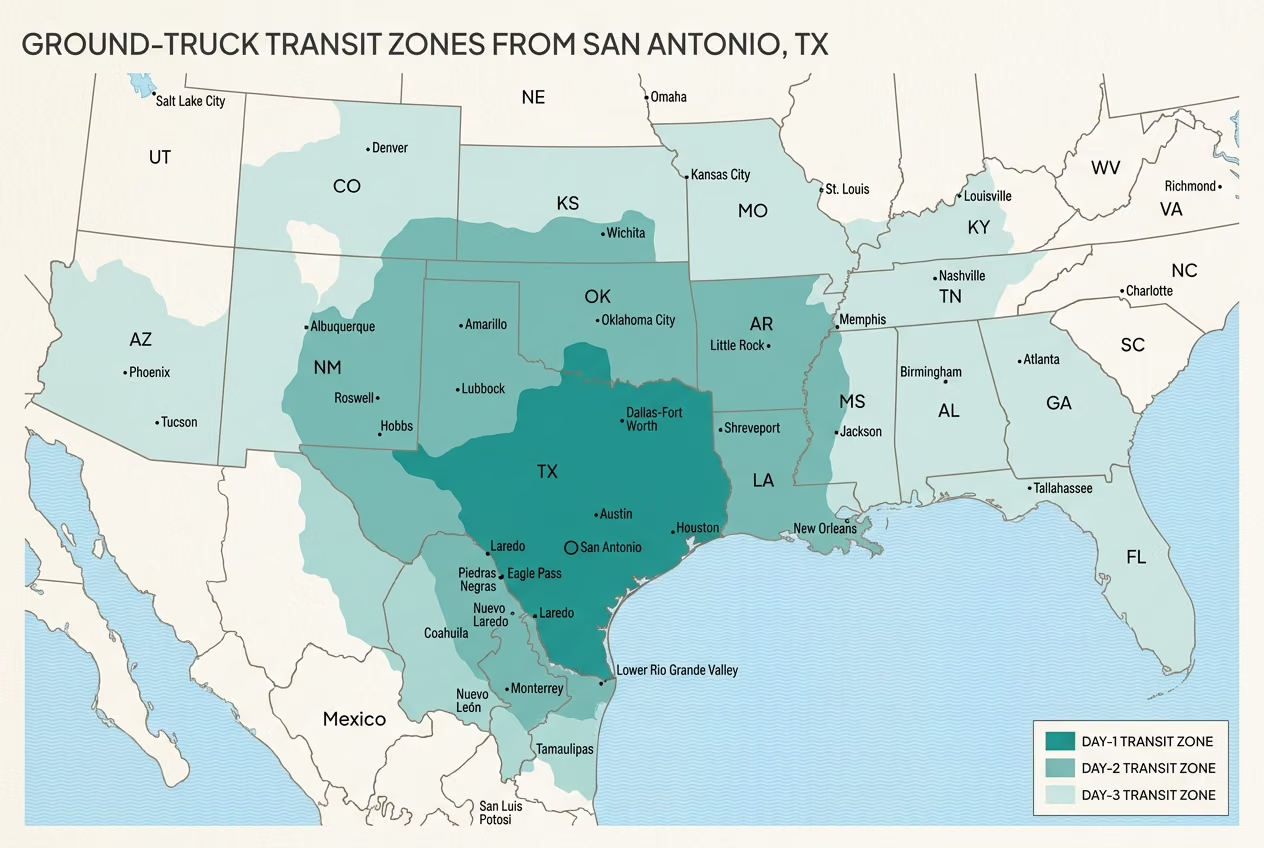
What 1-day and 2-day delivery from a San Antonio 3PL actually covers
From our San Antonio footprint, your inventory reaches a defined 1-day and 2-day ground zone, plus cross-border to Canada through our Canadian network. No separate Canadian 3PL setup required.
1-day delivery2-day deliveryOur San Antonio facility
1d
1-day delivery
Texas, Louisiana, Oklahoma, Arkansas, New Mexico, most of Mississippi, northern Mexico via Laredo / Eagle Pass
2d
2-day delivery
75% of U.S. homes, including Chicago, Atlanta, Phoenix, and the Mountain West
XB
Cross-border to Canada
1 business day to Toronto and Vancouver via our Canadian network.
2 PM CT
Same-day cutoff
2.6M (San Antonio MSA)
Metro pop served
3+
FBA codes routed
Comparison
Where in the San Antonio area should your 3PL actually be?
A few honest comparisons. We're not the right fit for every brand shipping from LA, and where we're not, here's where we'd send you.
Triple Freeport zero inventory tax inside 175 days, 2 PM CT cutoff, San Antonio metro W/D rate basis (well below Austin and Houston on equivalent space), multi-node split with our US/Canadian network, cross-border to Mexico via I-35 to Laredo and US-57 to Eagle Pass, FTZ #80 (Port SA) and FTZ #96 (Eagle Pass) routing coordination
Constraint
Best fit at 500+ DTC orders/month; ambient-only; not a designated FTZ ourselves
Best for
D2C brands shipping Texas Triangle + Central US + Mexico cross-border, importing through Laredo / Eagle Pass / Houston, Shopify and Amazon FBA multi-channel, Toyota-supplier-adjacent kitting / co-pack flow
In-SA boutique 3PL
The rare smaller in-SA ops named in r/sanantonio threads (HEB / Rittiman labor pool tier; Specs warehouse on Rector area)
Strength
Hands-on, no-monthly-minimums, founder-led; built for sub-500 order/month brands; close to HEB Rittiman + Specs warehouse labor depth; the r/Warehousing consensus is uniform: "If you hate the ticket system, look for boutique or Tier 3 3PLs"
Constraint
Smaller carrier rate cards; limited multi-node split; no Canadian network; limited Laredo / Eagle Pass FTZ #96 fluency; the r/FulfillmentByAmazon horror-story tier exists in Texas
Best for
Pre-revenue and growth-stage brands shipping under 500 orders/month, ex-ShipBob / ex-Red-Stag refugees looking for a dedicated account manager
Schertz / Selma / New Braunfels cluster operator
The honest "San Antonio 3PL" zip codes (Buske SA + Schertz; NXTPoint 107K SF at 5211 Deitrich; Crane Worldwide; Beltmann; Nippon Express Q3 2025 Toyota-tie-in 211K SF)
Strength
Inside Triple Freeport jurisdiction; Buske runs separate SA + Schertz nodes with food / beverage / auto / retail vertical specialization; NXTPoint is Texas-wide (also Austin + Dallas + Houston + Lubbock + El Paso) with Körber One WMS; Nippon Express is Japan-logistics with the Toyota / Sanko nearshoring tie-in
Constraint
Most have no Mexico cross-border lane focus; Buske and NXTPoint built for mid-market and enterprise tier, not always D2C; pricing reflects regional-network rates
Best for
Mid-market brands shipping high-volume into the Toyota / Sanko / JCB supplier flow, or NXTPoint Texas-wide platform fit
National multi-node 3PL
San Antonio is one of 30 to 60 fulfillment centers (ShipBob says "we do not have a fulfillment center in San Antonio at this time"; GEODIS, FIDELITONE, Saddle Creek, Speed Commerce serve SA from regional nodes; Red Stag actively writes against SA citing TX grid risk to redirect to Knoxville / SLC)
Strength
Dense FC network nationwide; platform-style integrations
Constraint
San Antonio node is not a focus; small-brand minimums; ShipBob and Red Stag explicitly do not have an SA facility, which means your inventory sits out-of-state and the "SA same-day" promise is marketing copy
Best for
Brands wanting national 2-day reach via inventory split, willing to pay national-network rates and accept that the "San Antonio" facility is actually in another state
Port SA / FTZ #80-10 specialty
Inside the 1,900-acre former Kelly AFB campus, the only public FTZ in SA (OpTech-managed)
Strength
Direct duty deferral inside FTZ #80; Boeing runs 1.6M SF of hangars (only DoD heavy-maintenance depot for the entire C-17 Globemaster III fleet); StandardAero's April 2026 Federal Register FTZ #80 production notification covers Rolls-Royce + CFM LEAP engine refurbishment; $2.1B annual aerospace economic impact, 12,000-14,000 direct workers
Constraint
Built for aerospace MRO, defense-depot work, and engine-core refurbishment, not D2C ecommerce; minimum-volume thresholds and FTZ overhead rarely pencil out for a Shopify brand. This is the "we don't do this" reference, not a competitor for DTC.
Best for
Aerospace OEMs, defense-depot tenants, Rolls-Royce / CFM LEAP engine MRO, and Toyota-tier industrial nearshoring with 7+ figure annual duty exposure
Vertex pricing
Pricing for San Antonio fulfillment
Pick-and-pack starts at $1.05 per DTC order. Everything else — receiving, storage, FBA prep, kitting, returns — is scoped to your SKU mix, channel set, and packout spec. Show us your current 3PL invoice and we'll tell you where we beat it, line by line.
Pick & pack
Per DTC order, standard SKU
from $1.05/order
Everything else
Receiving, storage, FBA prep, kitting, returns, multi-channel routing — quoted on a call against your real order volume and SKU profile. We do not publish a per-pallet or per-cu-ft rate sheet because the honest answer depends on what you ship.
Bring your current invoice
Already at another 3PL? Send us your last three invoices. We will reply with a side-by-side and tell you whether we can beat it. If we cannot, we will say so.
What every brand gets
Inventory sync to Shopify, Amazon, BigCommerce
Multi-carrier rate shop on every parcel
12 PM PT same-day cutoff at our Vancouver HQ
Scan-confirmed picking, not visual
No annual contract, no setup fee, no software fee
A named account lead on your account (not a ticket queue)
Bring your current invoice. We will reply with a line-by-line comparison.
FAQs about San Antonio fulfillment
Real San Antonio 3PL questions, answered
01 Where exactly is your San Antonio warehouse?
We operate in the San Antonio area as part of our 10-warehouse US and Canadian network, inside Triple Freeport jurisdiction (Bexar County, the City of San Antonio, Judson ISD, and SAISD have all opted in). The honest "San Antonio 3PL" address is Schertz, Selma, Cibolo, Live Oak, Universal City, New Braunfels, or the Southside Toyota corridor. Our footprint sits in the metro at the regional W/D rate, well below Austin or Houston on equivalent space.
02 Why does San Antonio sit at the intersection of Laredo and Eagle Pass?
San Antonio is the only US metro within a 2-hour drive of both Mexican border crossings. Laredo handled ~$800 billion in US-Mexico trade in 2025 (~35% of all US-Mexico binational trade, 20,000 commercial truck crossings per day per Pro Texas Industry and Lee & Associates). Eagle Pass cleared $43.75 billion in 2024 and is the fastest-growing US-Mexico crossing. We are 156 miles / 2 hours 14 minutes south of Laredo on I-35 and 143 miles / 2 hours 46 minutes southwest of Eagle Pass on US-57. No other US metro touches both crossings inside that radius.
03 What is the Triple Freeport Tax Exemption and how does it save me money?
Texas Tax Code 11.251 lets counties, cities, and school districts opt out of taxing inventory that leaves Texas within 175 days. Bexar County, the City of San Antonio, Judson ISD, and SAISD have all opted in, which is what "Triple Freeport" means in San Antonio. For a DTC brand shipping nationally from SA, every SKU that turns inside 175 days carries zero state inventory tax. We tag every inbound unit with a 175-day clock on receipt and flag any SKU approaching day 150 so you can decide to move it, clear it, or accept the tax hit before it triggers.
04 Do you operate inside FTZ #80 or FTZ #96?
No. We are not a designated Foreign Trade Zone ourselves. For brands where direct duty deferral is the right answer, we coordinate with FTZ #80 (City of San Antonio, grantee since September 16, 1982; Port San Antonio's full 1,900-acre campus is FTZ #80-10, OpTech-managed; Boeing and StandardAero hold subzones) and FTZ #96 (Eagle Pass / Maverick County Dev. Corp., expansion approved by the FTZ Board August 26, 2024). For most ecommerce brands, the Triple Freeport 175-day exemption pays back better than the FTZ overhead.
05 What is the cutoff time for same-day shipping in San Antonio?
Orders placed before 2 PM CT ship the same business day. Orders after the cutoff ship the next business day. Saturday cutoffs are available on request for high-volume DTC programs.
06 Do you route inventory to Amazon FBA from San Antonio?
Yes. We prep and route to SAT1, SAT2, and SAT5 directly from our San Antonio-area facility. FBA labeling, polybagging, and inbound shipment plans are all included. We re-validate FNSKUs on a recurring cadence so Amazon spec changes do not cause inbound rejections.
07 Can I ship cross-border from San Antonio to Mexico?
Yes. We are 2 hours from both Laredo and Eagle Pass and run DDP and DDU shipments to Monterrey, Saltillo, and Mexico City via Estafeta and DHL Express Mexico, handling customs entry filing, paperwork, and tax election in one workflow. We coordinate with FTZ #96 (Eagle Pass / Maverick County) for tariff-deferred routing on classifications where the math works.
08 Can I ship cross-border from San Antonio to Canada?
Yes. Cross-border to Canada is 2 to 3 business days from our San Antonio footprint via our Canadian network (covering Toronto and Vancouver). We handle DDP / DDU shipping, CUSMA origin routing, and customs paperwork in one workflow.
09 How does SAT air cargo factor in?
SAT (San Antonio International) moved 274,847,470 pounds of cargo in 2025, an all-time record and +15.7% year over year. We hold relationships with three air-cargo handlers at SAT for high-value or time-sensitive inbound and trans-load SAT-cleared cargo to our San Antonio-area dock the same day. SAT is in a $1.18B-class expansion, which is why air-cargo growth is accelerating versus DFW for SA-bound electronics and high-value goods.
10 What about Port San Antonio? Is that a maritime port?
No. Port San Antonio is the 1,900-acre former Kelly Air Force Base, now a multi-tenant aerospace + logistics + cybersecurity campus where the full footprint is FTZ #80-10. 80+ tenants, 19,000 employees, $10.6B contribution to Texas GDP in 2024. It houses Boeing's only DoD heavy-maintenance depot for the entire C-17 Globemaster III fleet (1.6M SF of hangar space) and StandardAero's engine MRO operation. For DTC fulfillment, Port SA is the FTZ tariff-sanctuary reference, not the dock; we coordinate with FTZ #80 partner brokers when the tariff math justifies it.
11 What about the Toyota / Sanko / JCB nearshoring stack? Does it matter for my brand?
It matters two ways. First, labor depth: Toyota TMMTX runs 3,700+ direct employees plus 20 on-site suppliers and 30+ near-plant suppliers, JCB opens October 2026 with 1,500 jobs ($500M / 1M SF), Sanko Texas is $40M / 300 jobs supplying Toyota plastics directly, Lefko USA is $15M / 150 jobs in New Braunfels, and the Toyota EDF study pegs 10-year economic impact at >$10B + 40,000 multiplier jobs. That keeps SA labor and carrier capacity deep year-round. Second, kitting / co-pack: DTC brands can sit alongside the manufacturing supply chain in the same buildings at industrial rates materially below Austin and Houston, a structural cost advantage.
12 What is the minimum order volume to work with Vertex in San Antonio?
We work best with brands shipping 500+ DTC orders per month or running B2B and retail replenishment programs. Below 200 orders per month, smaller in-SA boutique 3PLs (the rare smaller operators named in r/sanantonio threads) and 3PL match-services (Fulfill.com, Third Person, WareMatch) will beat us on cost. We say so on the discovery call.
13 Do you handle cold chain in San Antonio?
No. Our San Antonio-area facility runs ambient-only. For cold chain (frozen, refrigerated, freezer pharma, biologics, beauty cold storage), we refer to the Houston cold-chain tier or GMP-certified specialists. Americold (Q3 2025: 400K SF SA cold storage) and Lineage Logistics (SA Profit facility: 209,419 SF cold storage with rail access) both run SA cold storage, but at scale tiers that do not fit small-brand DTC.
14 How long does onboarding take?
Standard onboarding runs 1 to 2 weeks: discovery call, integration setup (Shopify, Amazon, your ERP), SOP design, and first inbound receiving. Brands with clean SKU data and a single sales channel can be live in under a week.
15 Do you require an annual contract?
No. We use service agreements, not contracts. You can pause, scale up or down, or move volume across our nodes (San Antonio, Austin, Dallas, Houston, LA, Atlanta, US, Canada) without penalty. Termination is 60 days written notice.
16 What WMS do you use?
Datex Footprint paired with TechDynamics. The combination gives us near-real-time inventory sync to Shopify and Amazon, barcode scanning at every pick and put-away, and EDI-compliant retail outbound for B2B programs. The Reddit r/FulfillmentByAmazon horror-story tier ("they cannot provide any inventory or accounting of the shipments we sent to them") happens when an operator runs without a real WMS or signed cycle-count SOPs; that is not us.
17 How do you handle returns from San Antonio customers?
Returns are received and inspected against your written disposition rules (restock, refurbish, scrap). The result writes back to your inventory in real time. You get a daily returns report. Refunds can trigger on receipt, on inspection, or on restock. You pick during onboarding.
Get a custom quote in 24 hours, based on your SKU mix, order volume, and Central US delivery needs. 2 PM CT cutoff. 24-hour receipt-to-pickable. No annual contract.