


CPSIA lot tracking from receipt to ship
Every unit received with lot number, production date, batch ID captured in the WMS. The lot stays bound to every shipped unit so if a recall lands, the affected-customer list generates in a day, not weeks.
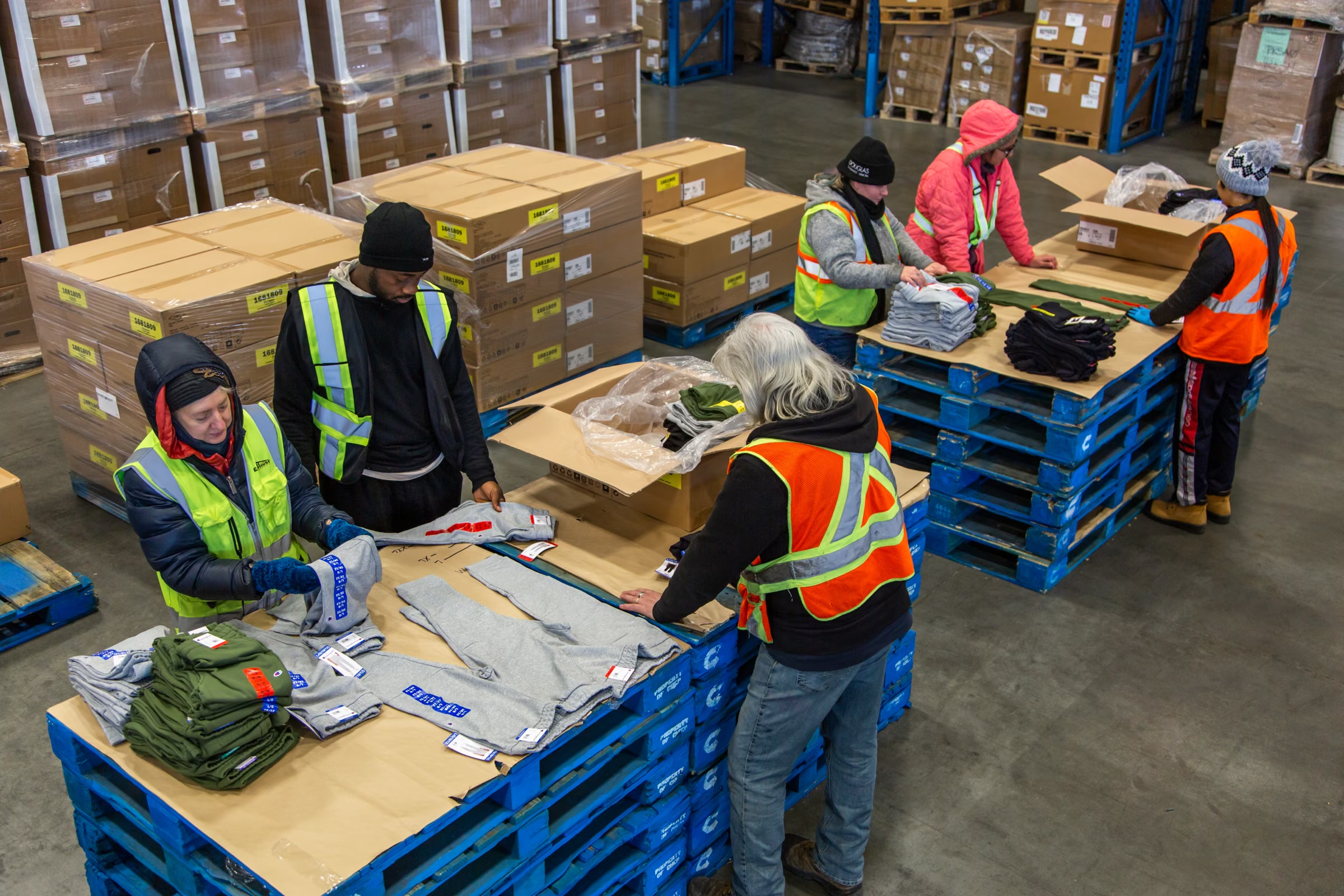
Baby products fulfillment with CPSIA tracking and age-grade routing. Built for brands shipping to Buy Buy Baby, Target, and Amazon registry.
Trusted by baby products brands shipping across North America

Toyota

Rad Power

Mystery Ranch

Brooklyn Bicycle

Cobian

BOCCI

Merkury




Written by the Vertex operations team
Marco, Kim, Tom & Sara · Receiving, Pick & Pack, FBA Prep, Account Management
Last reviewed by our baby products ops lead against current packout specs, carrier rules, and baby products brands feedback.
Baby products brands ship under one of the strictest consumer safety regimes in retail: CPSIA tracking labels are required by law on every children's product, ASTM F963 toy safety standards govern testing, and age-grade routing matters because a 3-year-old choking on a 12-month-only toy is a brand-ending event. A 3PL that handles baby without CPSIA discipline, age-grade enforcement, and gift-wrap workflows is one recall notice away from a brand crisis.
Key takeaways
Same-day dispatch: baby products orders that clear QC before the daily carrier cutoff ship the same business day, with weekend coverage available through peak.
CPSIA tracking labels are required by law on every children's product — coverage cannot lapse, audit trails must persist
Age-grade routing (12mo+, 3yr+, 8yr+) prevents choking-hazard mis-ships that turn into safety incidents
Registry gift-wrap is a first-class workflow — Buy Buy Baby plus Target plus Amazon Baby Registry plus brand DTC all need it
Returns spike on age-outgrow timing — predictable seasonal pattern, not a defect — requires refurb-vs-destroy logic
Why baby products
The average baby product is a regulated children's product under the CPSIA (Consumer Product Safety Improvement Act). Every unit requires a permanent tracking label with manufacturer, production date, batch identifier, and country of origin. The label must persist on the product or packaging through the customer's hands so the CPSC can trace a recall back to its lot. A 3PL that handles baby without lot-level traceability in the WMS cannot help you on the day the recall notice lands, and the recall notice will land.
Age grading is the second non-negotiable. Toy safety standards (ASTM F963) classify products by minimum age: 0-12 months, 12 months plus, 3 years plus, 8 years plus. A small-part toy shipped to a household with a 2-year-old when it was labeled 3-years-plus is the textbook choking hazard liability scenario. The 3PL has to read order metadata, age-grade flag at the SKU catalog level, and not let manual pick judgment override the rule. Most warehouses do not run baby with this discipline.
Channel mix in baby leans on Amazon plus Shopify plus retail wholesale (Buy Buy Baby, Target, Walmart Baby, Babylist), and the registry gift workflow runs through all of them. A registry order is gift-wrapped, gift-noted, ships to the gifter's name but the registrant's address, and often gets a registry-specific insert card. Subscription boxes (Lovevery, Monti Kids, KiwiCo) layer on age-grade-tiered shipments where the box contents change every 3 months as the child ages. The operations workflow has to read all of it.
What it unlocks
Vertical-specific operations, mapped to the failure modes the category produces.
Every unit received with lot number, production date, batch ID captured in the WMS. The lot stays bound to every shipped unit so if a recall lands, the affected-customer list generates in a day, not weeks.
Every SKU age-grade flagged at the catalog level. Order routing reads the registry or recipient metadata if available and surfaces mismatches before pack. Manual judgment should not override the rule.
Gift-wrap rules should read from your Shopify, Buy Buy Baby, Amazon Baby Registry, or Babylist order metadata. Gift box drops in automatically. Gift note prints on insert card. No manual list.
For Lovevery / Monti Kids / KiwiCo-model brands, the child's age reads from the contract record and routes the right age-tiered box at the right ship window. The age tier advances on the contract anniversary, not on manual flag.
For Shopify brands
Shopify plus Recharge plus Klaviyo plus a registry app is the typical DTC stack in baby products. The decision is whether you need a baby-aware 3PL or your current generic 3PL can handle the CPSIA plus age-grade plus registry stack.
Yes if
No if
Below 200 orders per month with no CPSIA exposure and no registry workflow, a generic 3PL is cheaper. Above that, the baby-specific workflows pay for themselves in recall readiness and registry conversion.
For Amazon FBA brands
Baby on Amazon flows through Amazon Baby Registry as the primary acquisition channel, plus FBA for ongoing fulfillment. FBA does not surface registry-specific gift logic, so most growing baby brands move off FBA once registry conversion matters.
Yes if
No if
Baby brands that care about Amazon Baby Registry conversion usually move off FBA and onto Seller Fulfilled Prime or our unified inventory pool so the gift-wrap workflow runs the same on every channel. Brands that do not care can stay on FBA and we handle the prep.
Scope
A baby products 3PL needs to handle the work that is specifically baby: CPSIA lot tracking from receipt through ship, age-grade enforcement at pick, registry gift-wrap workflows across all channels, and subscription age-tiering for boxes that change as the child grows. The brand owner should not need to micromanage tracking labels or chase registry gift-notes after onboarding.
A good 3PL will not write your safety testing protocol, will not design your insert cards, and will not run your registry-acquisition marketing. Those are inputs the operation reads; the work is the operation.
✓ The 3PL owns
✗ The brand owns
Order flow
Every baby products brand sees the same operational rhythm: receive, scan, slot, pick, pack, ship, track. The category-specific work happens at the pack station and on the exception desk. Here is the exact path, with the baby products-specific checkpoints inside it.
Inbound carton lands at the dock. The pallet is photographed, cases counted against the ASN, CPSIA lot number, production date, and batch ID captured on every children's product SKU at receipt.
Lot capture at receipt is the only thing that makes recall response work. Catch it at the dock or you will be paging through paper records on the day the CPSC notice lands.
Every unit scanned against the catalog. Age-grade (0-12mo, 12mo+, 3yr+, 8yr+), CPSIA tracking-label flag, and small-part choking-hazard flag written to the WMS at receipt.
Age-grade discipline starts at receipt. If the flag is not on the SKU at receipt, the pick-time enforcement check has nothing to verify against.
A-class SKUs go to fast-pick. Age-grade-flagged SKUs go to bins by tier so a pick error does not cross age-grade boundaries.
Physical separation by age grade reduces mis-pick risk. A 3yr+ toy in a 12mo+ bin is one tired-picker moment away from a choking-hazard shipment.
Order comes in from Shopify, Amazon Baby Registry, Buy Buy Baby, Target, Babylist, or EDI from wholesale. Order tags drive routing: registry order, gift-wrap, subscription age tier.
Channel routing drives packout. A registry order is gift-wrapped with a gift note; a subscription renewal is not. Same SKU, different operation.
Address validated against USPS / Canada Post. Registry orders cross-checked: gifter name to shipping label, registrant name to gift note. Age-grade mismatch flag holds for review.
Registry orders ship to the registrant's address but from the gifter's name on the label. Wrong cross-reference produces a returned gift and an awkward customer-service moment.
Every unit barcode-scanned at the bin. WMS verifies SKU plus qty plus age-grade against the order. Mismatch on age-grade blocks the pick.
Scan-confirmed picks with age-grade verify close the accuracy gap and the age-grade check catches the choking-hazard edge case before pack. The category does not tolerate visual picks.
Packer pulls the rule on the screen. Gift-wrap if registry order, insert card with gift note, age-grade insert if regulated. CPSIA tracking label verified visible on outer packaging.
Registry gift-wrap is a first-class workflow, not a packer judgment call. The rule reads the order metadata and the spec is on the screen.
Pack station scale verifies weight matches the BOM. Registry orders typically get a photo of the gift-wrapped box before sealing.
Photo evidence beats every "gift arrived ugly" registry complaint. The photo files against the order so it surfaces when the gifter asks why their wrap looked rushed.
Multi-carrier rate shop picks the cheapest compliant service. Registry orders to multi-unit dwellings flagged for signature-required. International shipments get country-specific children's product paperwork.
Registry gifts left in apartment hallways disappear. Signature-required on multi-unit destinations is a low-cost protection against a high-emotion customer event.
Trailer sealed, seal number logged, first-scan watched. The order-to-lot binding persists in the WMS so a future recall query returns the affected customer list fast.
Recall readiness is the invisible value of CPSIA discipline. You hope you never use it; the day you need it, you have a tight window to identify every affected customer.
Pricing reality
Most 3PL pricing comparisons get hung up on pick-and-pack rates, which are usually within a penny or two between providers. The real difference shows up in receiving, storage, and how baby products-specific exceptions are billed. Here is where to look:
| Cost area | How it's charged | What raises the invoice | What you must define |
|---|---|---|---|
| Pick + pack | From $1.05 per order, scoped to packout | Registry gift-wrap, gift-note inserts, age-grade-verify pick step | Whether gift-wrap and gift-note count as separate line items or roll into base |
| Packout supplies | Pass-through at cost plus handling | Gift-wrap paper, ribbon, registry insert cards, custom mailers | Whether brand owns supply orders or the 3PL sources on your behalf |
| CPSIA lot tracking | Included in pick + pack base | Multi-lot blended pick orders, recall query response time | Recall response SLA — target is a day; you may want faster |
| Returns processing | Quoted on call, base plus per-unit inspection | Age-outgrow vs defect vs saleable inspection, gift-return-to-gifter-address routing | Per-SKU rules: refurb threshold, destroy threshold, age-outgrow saleable threshold |
| Storage | Per cubic foot or pallet, scoped to volume | Multi-age-tier SKU storage, seasonal registry inventory, slow movers | Markdown date so slow stock does not eat margin in storage |
Failure modes
Five failure modes specific to baby products, not generic 3PL problems. The ones that hit at the pack station, the carrier hand-off, and the returns desk.
| Failure mode | Why it happens | How Vertex handles it |
|---|---|---|
| Recall notice lands, cannot identify affected customers in time | CPSIA lot tracking dropped at receipt or pick, no order-to-lot binding in WMS | CPSIA lot captured at receipt, bound to every shipped unit at pick. Recall query returns affected customer list within a day. |
| Choking-hazard toy shipped to household with younger child | Age-grade flag missing from SKU catalog, manual pick judgment overrode the rule | Age-grade flag mandatory at SKU catalog. Pick-time scan-verify blocks mismatch. No manual override at pick. |
| Registry gift arrives un-wrapped or with wrong gift-note | Registry order tag not read, gift-wrap workflow falls to packer judgment, gift-note printed on wrong order | Gift-wrap rule reads order metadata from Shopify / Buy Buy Baby / Amazon / Babylist. Insert card prints with the order at pick. Photo files for evidence. |
| Subscription box ships wrong age tier | Contract age advancement not read, picker grabbed the previous tier's box | Contract age reads ahead of ship window. Age tier advances on contract anniversary. Pick station shows the right tier for the right ship date. |
| Buy Buy Baby chargeback on CPSIA labeling compliance failure | Wrong GS1-128 label, missing CPSIA tracking label on outer pack, late ship window | EDI 850 / 856 / 810 automated through WMS. GS1-128 plus CPSIA labels generate at carton seal. Ship-window alerts early enough not to blow compliance windows. |
When this isn't a fit
We are not the right fit for every baby brand. If you ship under 200 orders a month with no registry channel and a single-age-tier catalog, a generic 3PL is cheaper and the baby-specific workflows do not pay back yet. If your products are not regulated children's products under CPSIA (adult-categorized maternity wear, postpartum care, parent-only items), the lot-tracking and age-grade overhead is more than your catalog needs.
Under 200 orders per month with no registry channel and no subscription program
Catalog is adult-categorized only (maternity wear, postpartum care, parent items) with no CPSIA exposure
Need same-hour fulfillment (we run same-shift, not same-hour)
Need on-site safety testing or CPSIA certification — we handle compliance paperwork at ship, not lab testing
Need cold-chain (formula refrigeration) — we are ambient plus climate-controlled, not cold-chain
Comparison
We are not the right fit for every baby products brand. Here is how we stack against the alternatives, and where we would send you if we are not it.
D2C baby brands with registry, subscription, and multi-channel volume
National multi-node platform 3PL
Hands-on operators serving 100-400 order/month indie baby brands
Multi-vertical, not baby-specialized
Vertex pricing
Pick-and-pack starts at $1.05 per DTC order. Everything else is scoped to your SKU mix, channel set, and packout spec. Show us your current 3PL invoice and we'll tell you where we beat it, line by line.
Pick & pack
Per DTC order, standard SKU
from $1.05 /order
Everything else
Receiving, storage, FBA prep, kitting, returns, multi-channel routing — quoted on a call against your real order volume and SKU profile. We do not publish a per-pallet or per-cu-ft rate sheet because the honest answer depends on what you ship.
Bring your current invoice
Already at another 3PL? Send us your last three invoices. We will reply with a side-by-side and tell you whether we can beat it. If we cannot, we will say so.
What every baby products brand gets
Bring your current invoice. We will reply with a line-by-line comparison.
FAQs about baby products fulfillment
Yes. Baby Products orders that clear QC before the daily carrier cutoff are picked, packed, and handed to the carrier the same business day, with weekend coverage available during peak. We confirm your exact cutoff time and SLA on the discovery call.
Every children's product SKU receives with lot number, production date, and batch ID captured in the WMS at the dock. The lot stays bound to every shipped unit. On the day a recall notice lands, the affected-customer list generates fast from a single WMS query.
Age-grade flagged at SKU catalog level (0-12mo, 12mo+, 3yr+, 8yr+). Pick-time scan verifies SKU age-grade against order. Mismatch blocks the pick and surfaces for review. Manual override at pick is not allowed.
Yes. Gift-wrap rules read order metadata from each registry channel. Gift box, ribbon, and gift-note insert card all generate automatically at pack. A photo of the wrapped box files against the order so disputes resolve fast.
The child's age reads from the subscription contract record ahead of the ship window. Age tier advances on the contract anniversary. The right age-tier box ships for the right month, automatically.
Yes. EDI 850 (PO), 856 (ASN), and 810 (invoice) integrate through the WMS. GS1-128 carton labels plus CPSIA tracking labels generate at carton seal. Ship-window alerts trigger early enough not to blow compliance windows.
Targeting a five-day onboarding cadence: contract signs and ops lead named, SKU catalog mapped with age-grade flags, CPSIA tracking, and lot fields, registry gift-wrap spec documented per channel with subscription age-tier rules locked, test orders run end-to-end including a recall-query test, registry integrations tested, shipping accounts connected, first inbound received, and the order feed flipped on.
Yes. Returns receive at the dock, inspected against a per-SKU rule tree: defect (destroy), age-outgrow (saleable if unopened, destroy if opened per FDA guidance on used baby goods), gift-return (route back to gifter address if requested).
Practical floor is 200 orders per month with registry, subscription, or CPSIA-flagged catalog. Below that, a generic 3PL is cheaper and the baby-specific overhead does not pay back yet. We are happy to refer you to a boutique operator if you are not at scale yet.
Related verticals
Related services
Ready to ship baby products the right way?
Get a custom quote in 24 hours based on your SKU mix, order volume, and baby products packout spec. Same-shift cutoff. 24-hour receipt-to-pickable. No annual contract.
5-day onboarding · 24h receipt-to-pickable · No annual contract